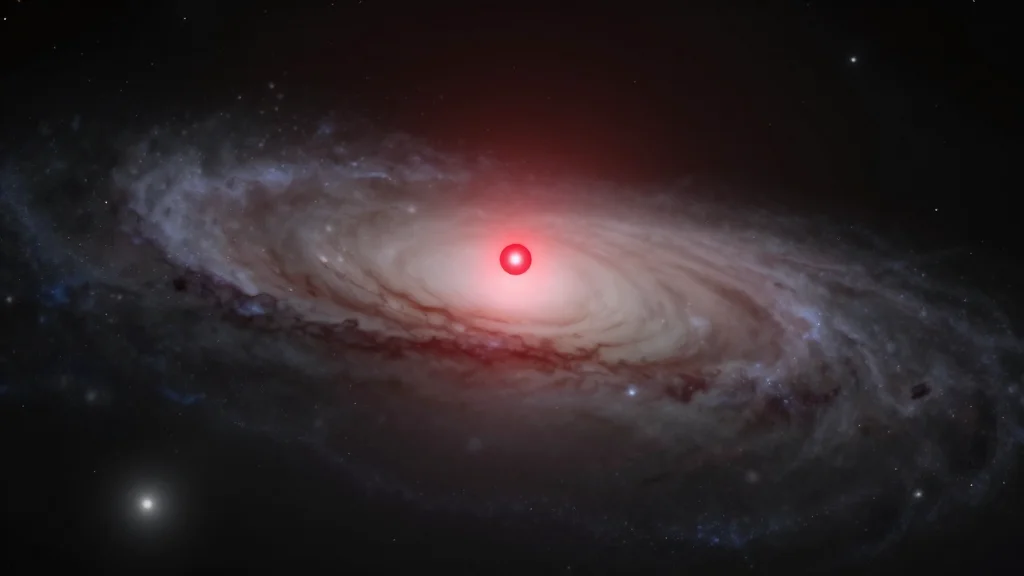
Black Hole Feeding Bursts May Explain JWST's Little Red Dots in Early Universe
Why It Matters
Understanding Little Red Dots sheds light on how the first supermassive black holes formed, a central unsolved problem in cosmology, and guides future JWST surveys toward a hidden population of early black holes.
Key Takeaways
- •Super‑Eddington accretion bursts grow early black‑hole seeds to 10⁵‑10⁶ M☉
- •Little Red Dots appear at redshift 5, a billion years after Big Bang
- •Mergers trigger nuclear bursts, creating V‑shaped UV‑optical spectra
- •Model predicts many fainter, undetected black holes beyond JWST’s current limits
- •Future evolution may link LRDs to compact dwarf or ultra‑compact galaxies
Pulse Analysis
The James Webb Space Telescope has catalogued hundreds of compact, red‑hued sources at redshifts around five, dubbed Little Red Dots (LRDs). Their tiny sizes, bright ultraviolet output, and lack of X‑ray or radio signatures have defied classification as ordinary galaxies or classic quasars, leaving astronomers without a clear formation pathway. This puzzle touches the core of a long‑standing question: how did the first supermassive black holes reach millions of solar masses within the first billion years after the Big Bang? The new study offers a concrete answer.
Chen and Mo combine a ΛCDM‑based galaxy‑formation framework with a self‑consistent treatment of black‑hole seed creation and growth. Seeds born in mini‑halos before redshift 20, already in the intermediate‑mass regime, experience episodic nuclear bursts—short, violent accretion events driven by mergers—that push the accretion rate up to ten times the Eddington limit. These super‑Eddington phases simultaneously ignite intense star formation, producing the observed V‑shaped spectrum: blue UV light from newborn stars and red optical emission from the rapidly feeding black hole. The model reproduces the observed LRD number density without fine‑tuning.
The authors argue that the detected LRDs represent only the brightest tip of a much larger, fainter population of black holes still in the burst phase, hidden below JWST’s current sensitivity. If future deep‑field observations confirm this hidden cohort, it would reshape estimates of early black‑hole demographics and tighten constraints on the physics of super‑Eddington accretion. Moreover, the predicted evolutionary pathways—some LRDs becoming compact dwarf galaxies, others merging into massive clusters—link early black‑hole growth directly to the later assembly of today's galaxy population.
Black hole feeding bursts may explain JWST's Little Red Dots in early universe
Comments
Want to join the conversation?
Loading comments...