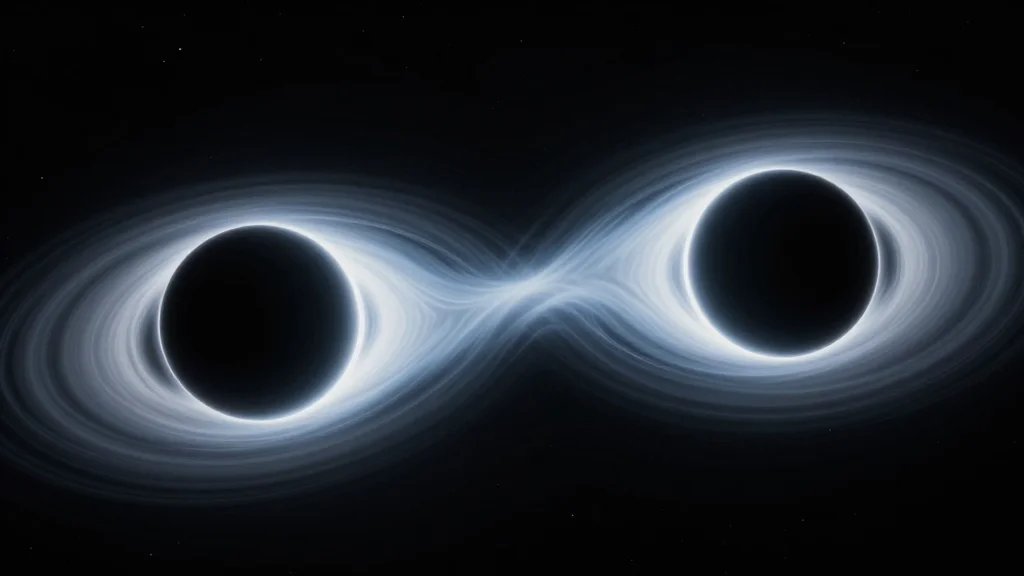
Black Hole Mergers Test the Limits of General Relativity
Why It Matters
These findings cement general relativity’s validity in extreme gravity while sharply limiting viable quantum‑gravity alternatives, guiding future theoretical and experimental work.
Key Takeaways
- •LVK 4th run data matches general relativity predictions
- •Post‑Newtonian analysis finds no dipole/quadrupole deviations
- •Graviton mass bound tightened to <2×10⁻²³ eV
- •No gravitational‑wave echoes detected after mergers
- •Alternative gravity models further constrained by observations
Pulse Analysis
The fourth observing run of the LIGO‑Virgo‑KAGRA (LVK) collaboration has delivered the most sensitive catalog of binary‑black‑hole mergers to date. By capturing the inspiral, merger and ringdown phases of dozens of events, researchers now possess a high‑precision laboratory for probing Einstein’s theory where gravity is extreme. Unlike earlier detections that were limited by signal‑to‑noise, the latest data set enables statistical tests of the full waveform against the predictions of general relativity, turning speculative ideas about its breakdown into measurable questions.
The three companion papers exploit this bounty in distinct ways. A global fit confirms that the observed waveforms are statistically indistinguishable from the general‑relativistic templates, while a post‑Newtonian parameter study finds no dipole or quadrupole anomalies, tightening the graviton‑mass upper limit to less than 2 × 10⁻²³ eV—orders of magnitude below the photon bound. A separate ringdown analysis searches for late‑time echoes that many quantum‑gravity proposals predict; the null result eliminates a wide class of exotic compact‑object models. Collectively, the work narrows the viable landscape for any theory that deviates from Einstein’s equations in strong fields.
Looking ahead, the next generation of detectors—such as LIGO‑A+, the Einstein Telescope, and Cosmic Explorer—will push sensitivity deeper into the kilohertz band, capturing fainter and more distant mergers. This expanded reach promises tighter constraints on post‑Newtonian coefficients, potential detection of subtle echo signatures, and even direct probes of the graviton’s dispersion relation. As the observational frontier expands, the synergy between gravitational‑wave astronomy and high‑energy theory will become a primary pathway toward a quantum theory of gravity, turning today’s null results into stepping stones for future breakthroughs.
Black hole mergers test the limits of general relativity
Comments
Want to join the conversation?
Loading comments...