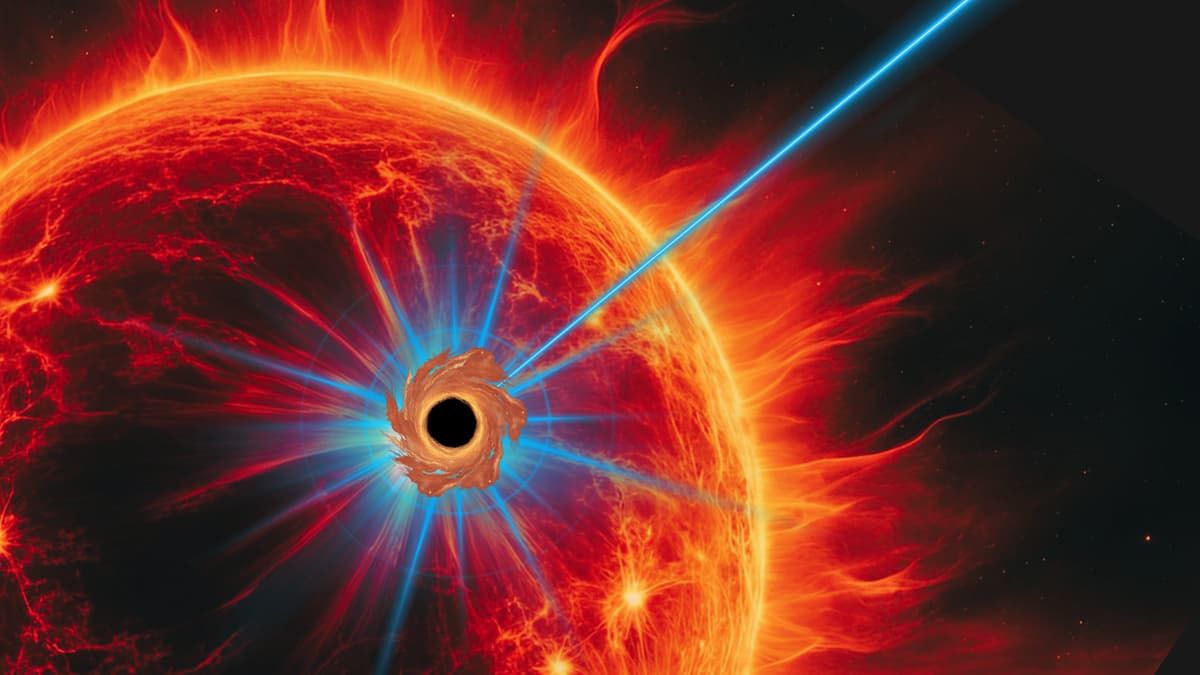
Black Holes Slamming Into Scorching Stars May Be Causing Mysterious Blue Flashes in the Cosmos
Companies Mentioned
Canva

Elsevier
Why It Matters
Understanding LFBOT origins clarifies a rare, extreme astrophysical process and refines models of binary stellar evolution, impacting predictions of gravitational‑wave sources and high‑energy transients.
Key Takeaways
- •Black holes or neutron stars colliding with Wolf‑Rayet stars likely cause LFBOTs.
- •LFBOTs occur in low‑mass, star‑forming galaxies, offset from dense regions.
- •Binary evolution creates compact‑object‑Wolf‑Rayet mergers after supernova kicks.
- •Rubin Observatory LSST will expand LFBOT sample for testing merger models.
- •Supernova and tidal‑disruption scenarios cannot explain LFBOT environments.
Pulse Analysis
Luminous Fast Blue Optical Transients have puzzled astronomers since the first detection in 2018, with only a handful identified to date. Their rapid rise, intense blue hue, and fleeting nature set them apart from conventional supernovae, prompting a scramble for a physical explanation. By situating LFBOTs within a broader catalog of high‑energy transients, researchers highlight the importance of pinpointing their progenitors to complete the taxonomy of explosive cosmic events.
The emerging consensus centers on a binary‑star pathway: a massive star stripped of its hydrogen envelope becomes a Wolf‑Rayet star, while its companion undergoes core collapse to form a black hole or neutron star. A supernova‑induced kick can displace the pair from crowded star‑forming zones, allowing the compact object to spiral inward over centuries or millennia. When the remnant finally merges with the Wolf‑Rayet core, the interaction ejects dense circumstellar material and produces the characteristic blue flash. This scenario neatly accounts for the observed offset locations, dense surrounding media, and rarity of LFBOTs, which align with the expected frequency of such finely tuned mergers.
Looking ahead, the Vera C. Rubin Observatory’s Legacy Survey of Space and Time promises to revolutionize LFBOT research. Its deep, high‑cadence imaging will uncover fainter, more distant events, expanding the statistical sample needed to validate the merger model. A larger dataset will also enable cross‑checks with gravitational‑wave observatories, potentially linking LFBOTs to compact‑object mergers detectable in the wave spectrum. As the field moves from speculation to empirical testing, the insights gained will sharpen our understanding of massive binary evolution and the extreme physics governing the most energetic explosions in the universe.
Black holes slamming into scorching stars may be causing mysterious blue flashes in the cosmos
Comments
Want to join the conversation?
Loading comments...