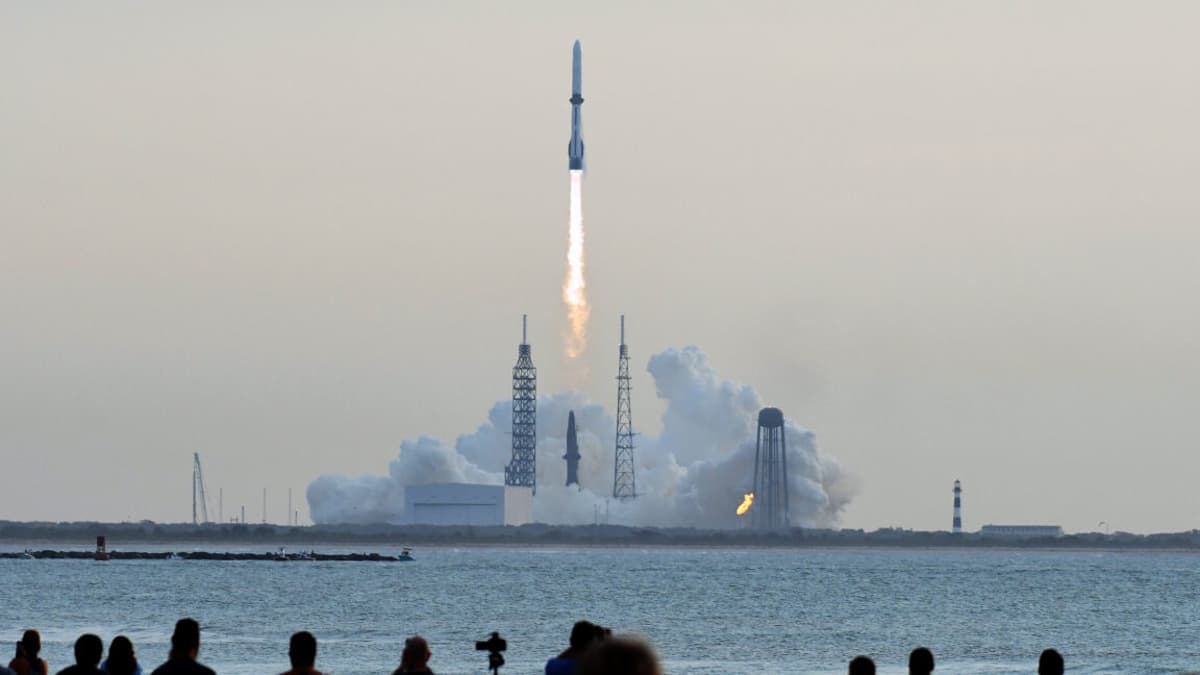
Blue Origin's Rocket Reuse Achievement Marred by Upper Stage Failure
Why It Matters
The mixed outcome highlights both progress in heavy‑lift reusability and a critical reliability gap that could delay Blue Origin’s role in NASA’s Artemis program and its competition in the emerging LEO broadband market.
Key Takeaways
- •Blue Origin successfully reflown New Glenn first stage, landing on drone ship.
- •Upper stage placed AST SpaceMobile satellite into off‑nominal low orbit.
- •Satellite will be de‑orbited; cost covered by insurance.
- •Failure could delay New Glenn’s Artemis lander launches.
- •SpaceX and Amazon push LEO broadband as Blue Origin battles reliability.
Pulse Analysis
Blue Origin’s latest New Glenn flight marks a milestone for the company’s heavy‑lift ambitions. By reflighting the first stage and recovering it on a drone ship, Blue Origin joins SpaceX in demonstrating that large, methane‑fueled boosters can be turned over quickly, a prerequisite for higher launch cadence and lower per‑launch costs. The achievement is especially notable because New Glenn is three times taller than the New Shepard sub‑orbital vehicle, making its reuse a far more complex engineering challenge.
The mission’s upside was quickly eclipsed by an upper‑stage anomaly that left AST SpaceMobile’s BlueBird 7 satellite in an orbit roughly half the intended altitude. At about 95 miles (154 km), the orbit is too low for the satellite’s thrusters to sustain operations, prompting an insurance‑covered de‑orbit. This failure underscores the difficulty of mastering upper‑stage performance on new heavy‑lift rockets, a problem that has also plagued SpaceX’s Starship development. For AST, the loss is a financial hit but also a reminder of the risks inherent in relying on emerging launch providers for LEO broadband constellations.
Looking ahead, the setback could ripple into NASA’s Artemis schedule. Blue Origin’s New Glenn is slated to launch the first prototype of the Blue Moon lunar lander, a critical component of NASA’s plan to return astronauts to the Moon by 2028. Any delay in proving New Glenn’s reliability may push back lander test flights, giving competitors like SpaceX and United Launch Alliance a strategic advantage. As Amazon expands its own satellite network and SpaceX’s Starlink continues to dominate, Blue Origin must resolve its upper‑stage issues to stay competitive in both lunar exploration and the fast‑growing LEO broadband market.
Blue Origin's rocket reuse achievement marred by upper stage failure
Comments
Want to join the conversation?
Loading comments...