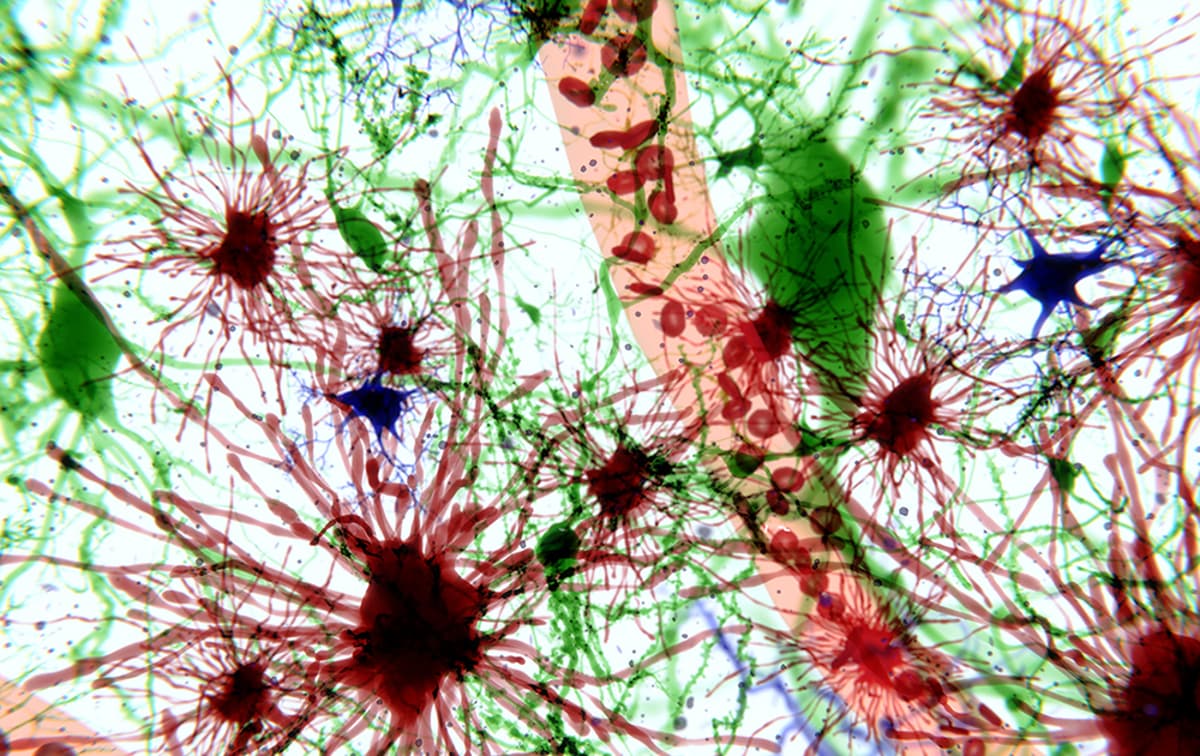
Brain Astrocytes Form Far-Reaching Connections in Mice
Why It Matters
By revealing that astrocytes create specific, long‑distance signaling routes, the study challenges the neuron‑centric view of brain connectivity and highlights a potential target for treating disorders such as Alzheimer’s and Parkinson’s.
Key Takeaways
- •Astrocytes form long-range, gap‑junction networks linking distant brain regions
- •Network tracing uses virus‑delivered tracers and whole‑brain clearing for 3D mapping
- •Gap‑junction knockout mice lose astrocyte pathways, confirming functional dependence
- •Sensory deprivation shrinks specific astrocyte routes, showing experience‑driven plasticity
- •Low‑cost tracing platform enables broader study of astrocyte roles in disease
Pulse Analysis
The discovery that astrocytes construct extensive, gap‑junction‑mediated webs reshapes our understanding of brain architecture. For decades, neuroscientists have focused on neuronal axons as the primary conduits of information, relegating astrocytes to a supportive role. This new evidence positions astrocytes as active participants in inter‑regional communication, suggesting that the brain’s functional map is more intricate than previously thought. By mapping these pathways in mice, researchers provide a template for exploring similar mechanisms in the human brain, where astrocyte density and gap‑junction prevalence are even higher.
A key innovation behind the breakthrough is a custom tracing system that combines a harmless viral vector with whole‑brain clearing and high‑resolution microscopy. The virus delivers a molecular tag that hops across gap junctions, allowing scientists to capture a three‑dimensional snapshot of every connected astrocyte. This approach overcomes the limitations of slice electrophysiology, which can disrupt delicate networks. The low‑cost, reproducible nature of the method means laboratories worldwide can adopt it to investigate astrocyte involvement in conditions ranging from glaucoma to Alzheimer’s disease, accelerating translational research.
Looking ahead, the dynamic nature of astrocyte networks—evidenced by their remodeling after sensory loss—opens exciting possibilities for therapeutic intervention. If experience‑driven plasticity can be harnessed, clinicians might one day modulate astrocyte connectivity to restore function after injury or slow neurodegeneration. Ongoing studies aim to identify the specific metabolites and signaling molecules that travel these pathways, as well as to verify whether comparable networks exist in humans. Such insights could lead to novel drug targets that address the supportive, yet often overlooked, cellular infrastructure of the brain.
Brain Astrocytes Form Far-Reaching Connections in Mice
Comments
Want to join the conversation?
Loading comments...