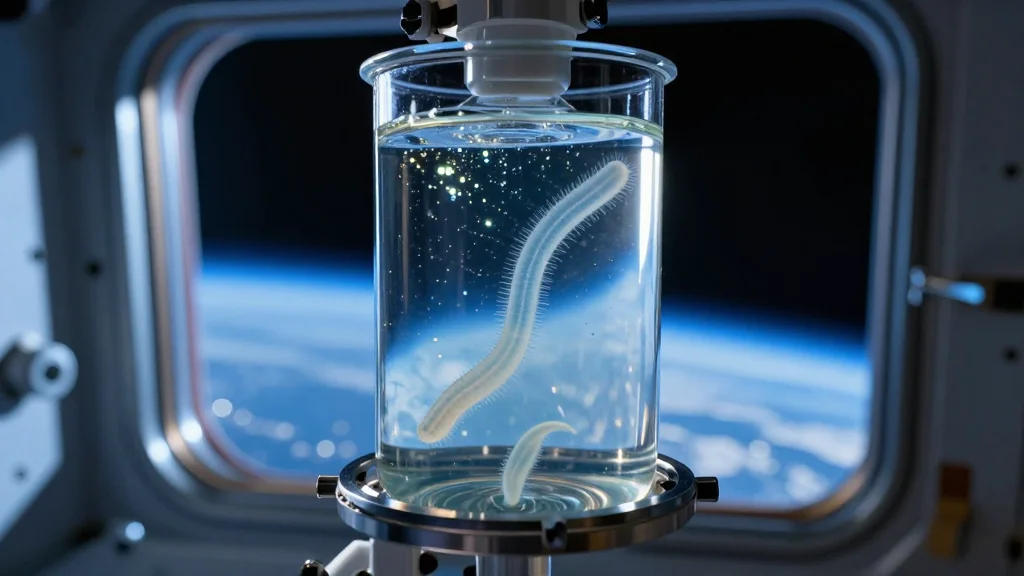
British 'Space Worms' Reach ISS to Test Microbial Support for Moon Missions

Why It Matters
Understanding how simple multicellular organisms and their microbial partners respond to microgravity is a cornerstone for building self‑sustaining habitats beyond Earth. If microbes can be coaxed into producing oxygen, recycling waste, or generating food precursors, future lunar bases could operate with far less reliance on costly resupply missions. Moreover, the experiment informs planetary protection policies by testing containment strategies for living organisms in space, a critical consideration as humanity expands its footprint on the Moon and Mars. The "Space Worms" study also contributes to a broader scientific narrative about life’s adaptability. Demonstrating that a microscopic crew can survive and function in orbit strengthens the case for using biology as a tool for space exploration, potentially reshaping mission architecture and reducing the environmental footprint of off‑world settlements.
Key Takeaways
- •British consortium launches microscopic worms to the ISS on April 10, 2026.
- •Experiment monitors growth, reproduction, and metabolism in microgravity for six months.
- •Data will inform bioregenerative life‑support systems for lunar habitats.
- •Findings could lower resupply costs for Artemis and private lunar missions.
- •Study addresses planetary protection by testing containment of living organisms in space.
Pulse Analysis
The "Space Worms" payload marks a strategic shift from purely engineering‑focused life‑support solutions toward biologically driven systems. Historically, space agencies have relied on closed‑loop mechanical recycling; however, the mass and energy penalties of such hardware have become a limiting factor for deep‑space missions. By leveraging the innate efficiency of microbial processes, the UK team is tapping into a paradigm that could dramatically cut payload mass and operational complexity.
From a competitive standpoint, the United States and China have both invested heavily in bioregenerative research, but the UK’s rapid deployment of a live multicellular model gives it a unique foothold in the emerging market for space‑based biotech. If the worms demonstrate robust metabolic activity, commercial entities may soon pursue scaled‑up bioreactors for oxygen generation, nitrogen fixation, or even protein synthesis, creating a new industry niche that bridges aerospace and synthetic biology.
Looking ahead, the experiment’s success will likely influence policy and funding decisions within ESA and NASA, prompting more collaborative missions that integrate biology into habitat design. The next logical step is a lunar Gateway experiment that subjects the same organisms to partial gravity and higher radiation levels, bridging the gap between low‑Earth orbit and the lunar surface. Such incremental testing will be essential to de‑risk the deployment of full‑scale bioregenerative habitats for Artemis III and beyond, ultimately shaping the economics and sustainability of humanity’s return to the Moon.
British 'Space Worms' Reach ISS to Test Microbial Support for Moon Missions
Comments
Want to join the conversation?
Loading comments...