Bumblebees Use Tools to Solve Complex Problems—Despite Not Being Trained to Do So
Why It Matters
The discovery challenges the long‑held view that high cognitive ability requires large brains, reshaping our understanding of insect intelligence and its implications for robotics and pollinator research.
Key Takeaways
- •16 of 22 bumblebees solved the ball‑rolling puzzle without training
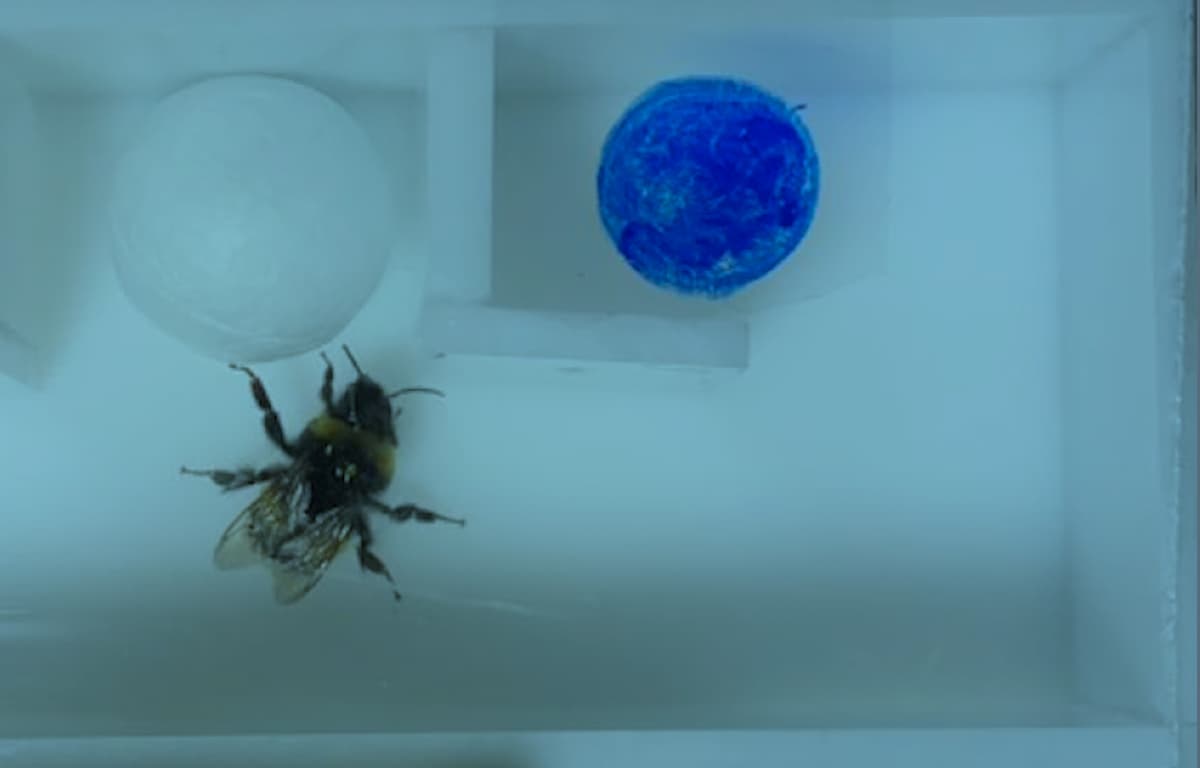
- •Bees used a Styrofoam ball to reach a sugary reward
- •Some individuals bypassed the tool, hanging from the ceiling to cheat
- •Findings question the assumption that larger brains guarantee higher cognition
Pulse Analysis
Tool use has long been considered a hallmark of higher vertebrates, from primates swinging sticks to extract termites to crows fashioning hooks for eggs. In insects, evidence is scarcer but growing; a 2016 study showed bumblebees could learn to pull strings after observing peers. The latest research published in Science adds a striking new layer, demonstrating that bumblebees can independently devise a novel solution—rolling a Styrofoam ball to climb toward a sugary reward—without any prior instruction. This finding pushes the boundary of what small‑brained organisms are capable of.
The experiment placed bees in a sealed chamber with several pits and a floating flower containing sugar solution. Only by moving a lightweight ball into the correct pit could a bee reach the flower, a task that bears no resemblance to natural foraging. Sixteen of the twenty‑two participants succeeded, showing rapid problem‑solving and spatial reasoning. Intriguingly, a handful of individuals bypassed the intended tool altogether, hanging from the ceiling to sip the reward, a form of ‘cheating’ that reveals flexible decision‑making. The results underscore a level of behavioral plasticity rarely attributed to insects.
These insights have ripple effects beyond entomology. Demonstrating sophisticated cognition in a brain of roughly one million neurons questions the neuron‑count paradigm that links brain size to intelligence, informing comparative neuroscience and the design of minimalist artificial agents. For agriculture, understanding bee problem‑solving could improve pollinator management and inspire bio‑inspired robotics capable of manipulating objects in constrained environments. The researchers plan follow‑up work to monitor physiological markers of insight, a step that may finally capture the elusive ‘aha!’ moment in an invertebrate brain.
Bumblebees use tools to solve complex problems—despite not being trained to do so
Comments
Want to join the conversation?
Loading comments...