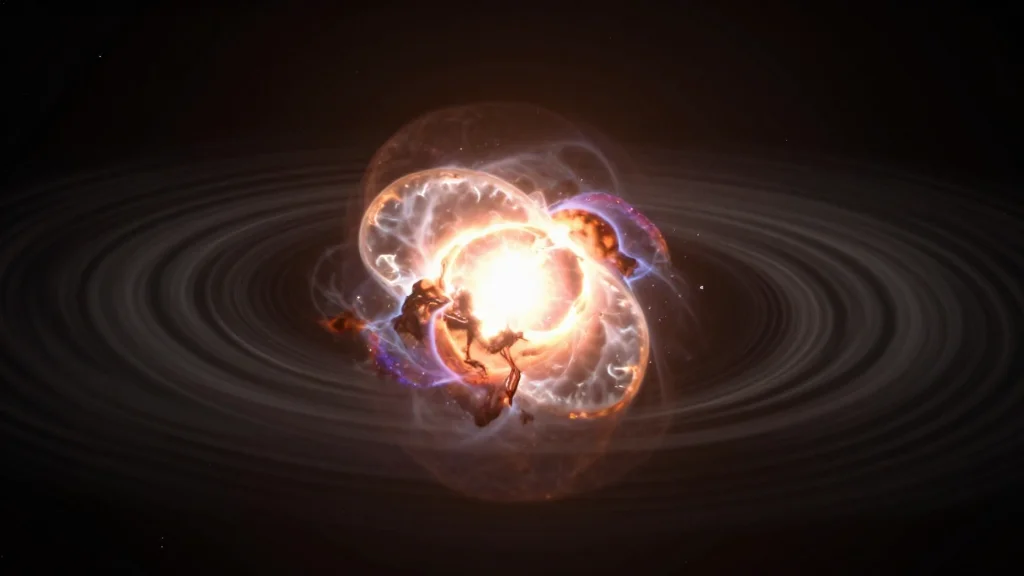
Can the Cataclysmic Explosions of Dying Stars Help Unlock Grand Mysteries of the Universe?
Why It Matters
Detecting gravitational waves from a core‑collapse supernova would close a critical gap in multi‑messenger astronomy, unlocking direct insight into the explosion mechanism and element formation that electromagnetic observations miss.
Key Takeaways
- •Core‑collapse supernovae forge most elements heavier than iron
- •Gravitational waves from such supernovae remain undetected to date
- •OzGrav’s combined BayeWave‑cWB method isolates low‑frequency signatures
- •Galactic supernova expected roughly once per century; readiness is crucial
Pulse Analysis
Core‑collapse supernovae are the universe’s elemental forges, converting massive stellar cores into the heavy atoms that make up planets, technology, and life itself. When a star exceeding eight solar masses exhausts its nuclear fuel, its core collapses into a neutron star, triggering a shock wave that blasts the outer layers into space. This cataclysm not only seeds galaxies with iron, gold, and uranium but also generates a fleeting pulse of gravitational waves—ripples in spacetime that carry pristine information about the star’s interior dynamics.
Since the first detection of gravitational waves from binary black‑hole mergers in 2015, LIGO, Virgo, and KAGRA have cataloged hundreds of events, yet none have originated from a core‑collapse supernova. The primary obstacle is sensitivity: merger signals are orders of magnitude louder, allowing detection across billions of light‑years, whereas supernova‑generated waves are faint enough to be observable only within our own galaxy. This limitation makes the rare galactic supernova—a phenomenon expected roughly once every hundred years—a high‑stakes opportunity for astrophysicists seeking to validate theoretical models of neutrino‑driven explosions and stellar nucleosynthesis.
Anticipating that moment, OzGrav’s collaborative team has refined a hybrid analysis pipeline that merges BayeWave’s Bayesian reconstruction with coherent WaveBurst’s pattern‑recognition capabilities. By focusing on low‑frequency (<250 Hz) components, the system can flag signatures indicative of pre‑explosion convection or rapid rotation, clues that differentiate competing explosion theories. As detector upgrades push sensitivity deeper into the Milky Way, this ready‑made framework ensures that when the next supernova lights up our sky, scientists will extract maximal scientific return—potentially reshaping our understanding of how the cosmos creates its most complex elements.
Can the cataclysmic explosions of dying stars help unlock grand mysteries of the universe?
Comments
Want to join the conversation?
Loading comments...