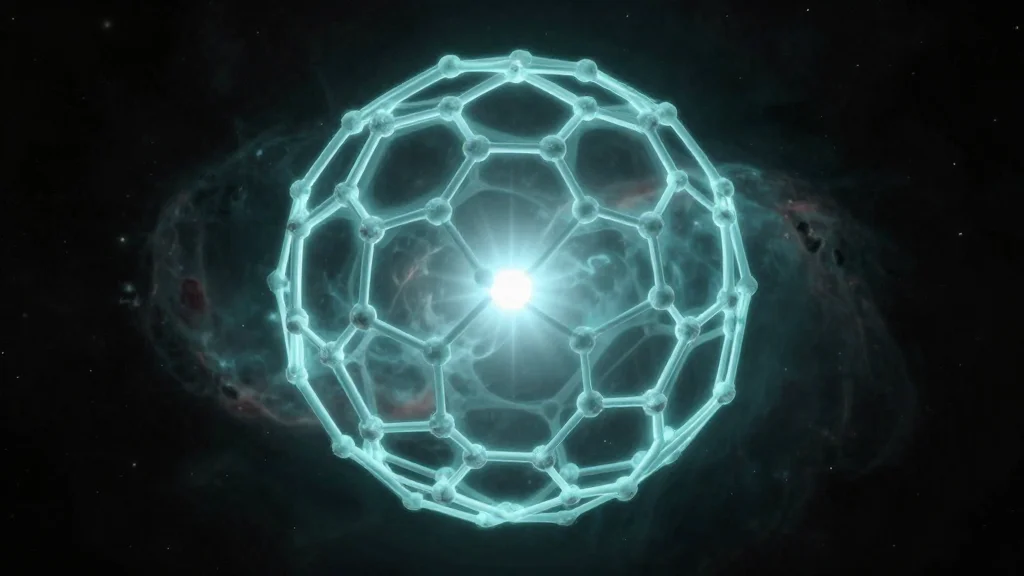
Canada’s Latest JWST Observation Shows ‘Buckyballs’ in Space
Companies Mentioned
Why It Matters
Imaging cosmic buckyballs clarifies how complex carbon molecules form and survive in harsh stellar environments, informing models of chemical evolution across the galaxy. The work also showcases Canada’s strategic role in JWST science, leveraging national hardware contributions for high‑impact discoveries.
Key Takeaways
- •JWST MIRI captured high‑resolution buckyball shell in nebula Tc 1.
- •Western University leads global research on cosmic fullerenes since 2010.
- •Canada’s CSA contributed FGS and NIRISS instruments, securing JWST time.
- •New observations will inform carbon chemistry in extreme stellar environments.
- •Upcoming Cycle 5 projects aim to test fullerene physics and unexpected carbon chemistry.
Pulse Analysis
The detection of buckminsterfullerene, or "buckyballs," in the planetary nebula Tc 1 marks a milestone for astrochemistry. While the molecule was first identified in space a decade ago, the James Webb Space Telescope’s Mid‑Infrared Instrument now resolves the full spherical shell of C₆₀ surrounding the dying star. This unprecedented clarity lets scientists map the distribution, temperature, and excitation of the carbon cages, offering a rare glimpse into how complex organics survive the intense radiation and shock waves of late‑stage stellar evolution.
Understanding fullerene formation is crucial because these robust carbon structures serve as building blocks for more intricate organic chemistry in the interstellar medium. Their resilience under extreme ultraviolet flux and high‑temperature conditions suggests pathways for carbon to persist and later participate in planet‑forming disks. By analyzing the spectral fingerprints captured by JWST, researchers can refine models of carbon grain growth, assess the role of fullerenes in dust processing, and gauge their contribution to the organic inventory that eventually seeds nascent planetary systems.
Canada’s involvement underscores the strategic value of national contributions to flagship missions. The Canadian Space Agency supplied the Fine‑Guidance Sensor and the Near‑Infrared Imager and Slitless Spectrograph, earning valuable observation slots for domestic teams. Western University’s ongoing program, now entering Cycle 5, will extend the study with MIRI and NIRSpec to test fullerene physics and explore unexpected carbon chemistry in oxygen‑rich ejecta. These efforts position Canada at the forefront of space‑based molecular astrophysics, fostering collaborations that translate cutting‑edge telescope data into broader scientific and technological advances.
Canada’s latest JWST observation shows ‘buckyballs’ in space
Comments
Want to join the conversation?
Loading comments...