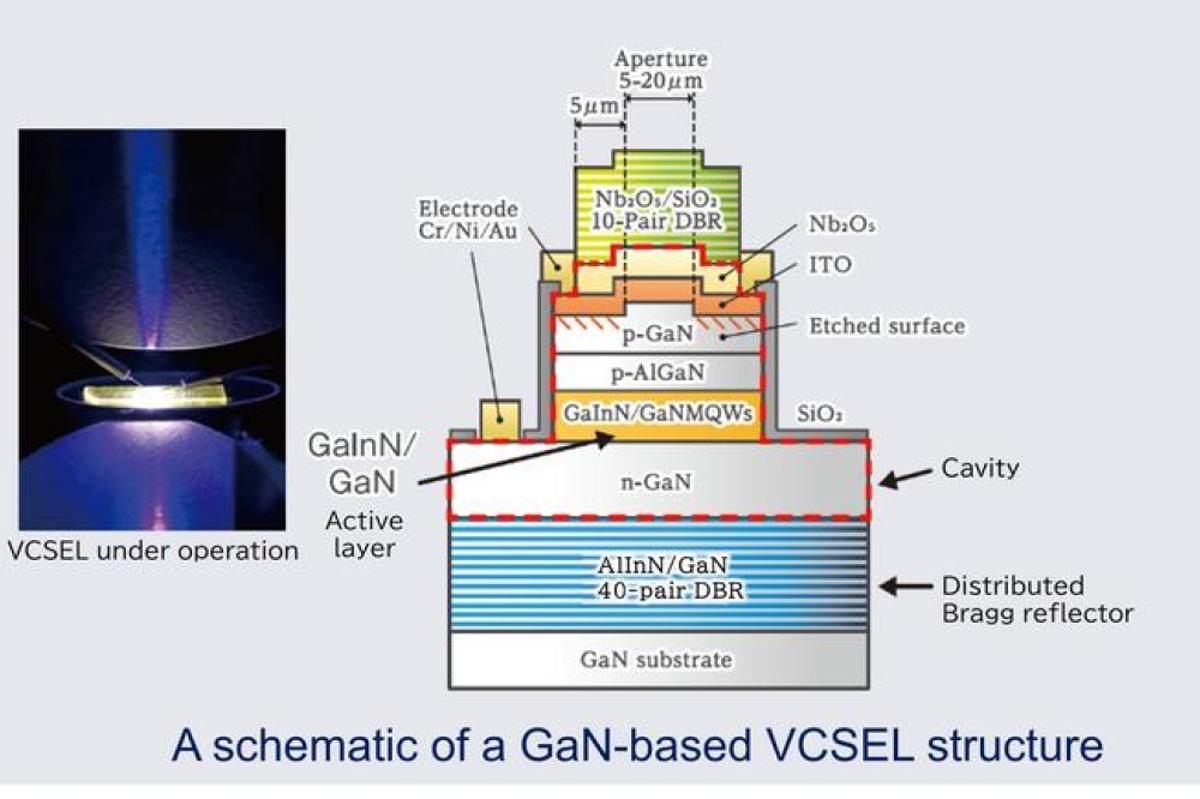
Cavity Control Boosts Performance of Blue VCSEL Lasers
Why It Matters
The breakthrough provides a practical pathway to high‑efficiency visible‑light lasers, accelerating their adoption in displays, sensing, and optical communications. Industry players can now target lower power consumption and higher output without redesigning material systems.
Key Takeaways
- •Cavity tuning adjusts resonance wavelength, reducing mirror loss.
- •Mirror‑loss range 35–40 cm⁻¹ yields >25% wall‑plug efficiency.
- •Study achieved 26.4% wall‑plug efficiency, a record for GaN VCSELs.
- •Injection efficiency measured at ~85%, internal loss ~11 cm⁻¹.
- •Findings guide design of high‑efficiency visible‑light lasers.
Pulse Analysis
GaN‑based vertical‑cavity surface‑emitting lasers (VCSELs) have long promised compact, low‑cost light sources for next‑generation displays, LiDAR sensors, and short‑range optical links. Yet their wall‑plug efficiencies have lagged behind competing technologies, limiting commercial rollout. Traditional research focused on gain detuning—adjusting the active region’s emission spectrum—to improve performance, but this approach alone cannot overcome intrinsic mirror losses that dominate the device’s optical budget.
The Meijo University team turned a manufacturing challenge into a research advantage by systematically measuring resonance‑wavelength shifts across a wafer. Their analysis revealed that small deviations in cavity resonance dramatically alter the distributed Bragg reflector’s mirror loss, ranging from 25 to 50 cm⁻¹. By targeting an optimal loss window of 35‑40 cm⁻¹, they achieved a wall‑plug efficiency of 26.4%, an unprecedented figure for visible‑light VCSELs. The study also quantified an injection efficiency near 85% and internal losses around 11 cm⁻¹, providing a clear performance map for device engineers.
For the photonics market, these insights translate into faster time‑to‑market for high‑efficiency VCSEL modules. Manufacturers can now incorporate cavity‑tuning metrics into wafer‑level process controls, reducing the need for costly post‑fabrication trimming. The methodology also opens doors for scaling to laser arrays and integrating two‑dimensional VCSEL architectures, which are critical for high‑power applications such as automotive LiDAR and data‑center interconnects. As the industry pushes toward greener, more power‑efficient photonic components, cavity‑tuned GaN VCSELs are poised to become a cornerstone technology.
Cavity control boosts performance of blue VCSEL lasers
Comments
Want to join the conversation?
Loading comments...