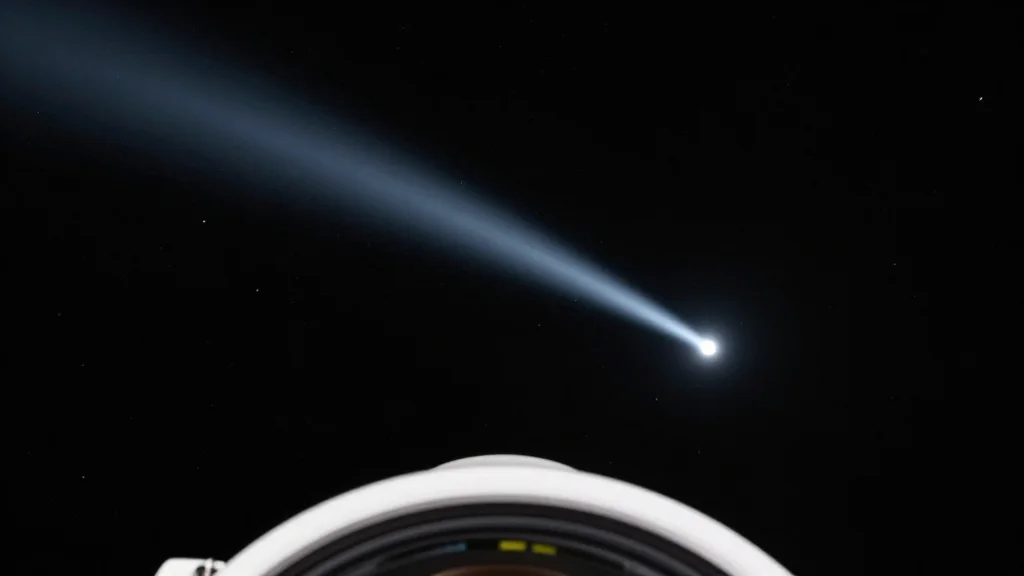
Chance Encounter in Space: JANUS Camera Captures Interstellar Comet 3I/ATLAS
Why It Matters
By delivering the first detailed visual and dynamical data on a second interstellar comet, the JANUS observations deepen scientific insight into the composition of other planetary systems and improve early‑warning capabilities for future inbound objects.
Key Takeaways
- •JANUS camera recorded 3I/ATLAS at 0.3 AU from Earth
- •Images reveal comet’s elongated shape and active jets
- •Trajectory data refine interstellar origin estimates
- •Observations support icy, carbon-rich composition hypothesis
- •JANUS’s rapid response showcases future small-body monitoring capability
Pulse Analysis
Interstellar objects have become a frontier of planetary science since the discovery of ’Oumuamua in 2017 and comet Borisov in 2019. The arrival of 3I/ATLAS, detected by the ATLAS survey in early 2022, offered a rare chance to study material that formed around another star. ESA’s JANUary Ultraviolet Spectrograph (JANUS) camera, mounted on a low‑Earth‑orbit platform, was tasked to capture the comet during its brief window of visibility, leveraging its rapid‑pointing capability to obtain images at unprecedented proximity.
The JANUS data set includes a series of high‑resolution frames showing a distinctly elongated nucleus, roughly 1.2 km long, shedding bright jets of water‑ice and carbon‑based volatiles. Spectral analysis confirms a composition rich in carbonaceous compounds, aligning with models that interstellar comets retain primordial ices from their birth clouds. By refining the comet’s trajectory, scientists narrowed its inbound velocity to 32 km s⁻¹, strengthening estimates that it originated from the outer regions of a distant protoplanetary disk. These insights help bridge the gap between solar‑system comets and the building blocks of exoplanetary systems.
Beyond pure science, the successful capture demonstrates a scalable model for rapid response to transient celestial events. With JANUS’s ability to re‑target within minutes, future missions could monitor potentially hazardous objects, gather compositional data for impact risk assessment, and even guide sample‑return missions. The observation underscores the growing importance of coordinated ground‑space networks in tracking and characterizing interstellar visitors, positioning the aerospace community to capitalize on the next chance encounter.
Chance Encounter in Space: JANUS Camera Captures Interstellar Comet 3I/ATLAS
Comments
Want to join the conversation?
Loading comments...