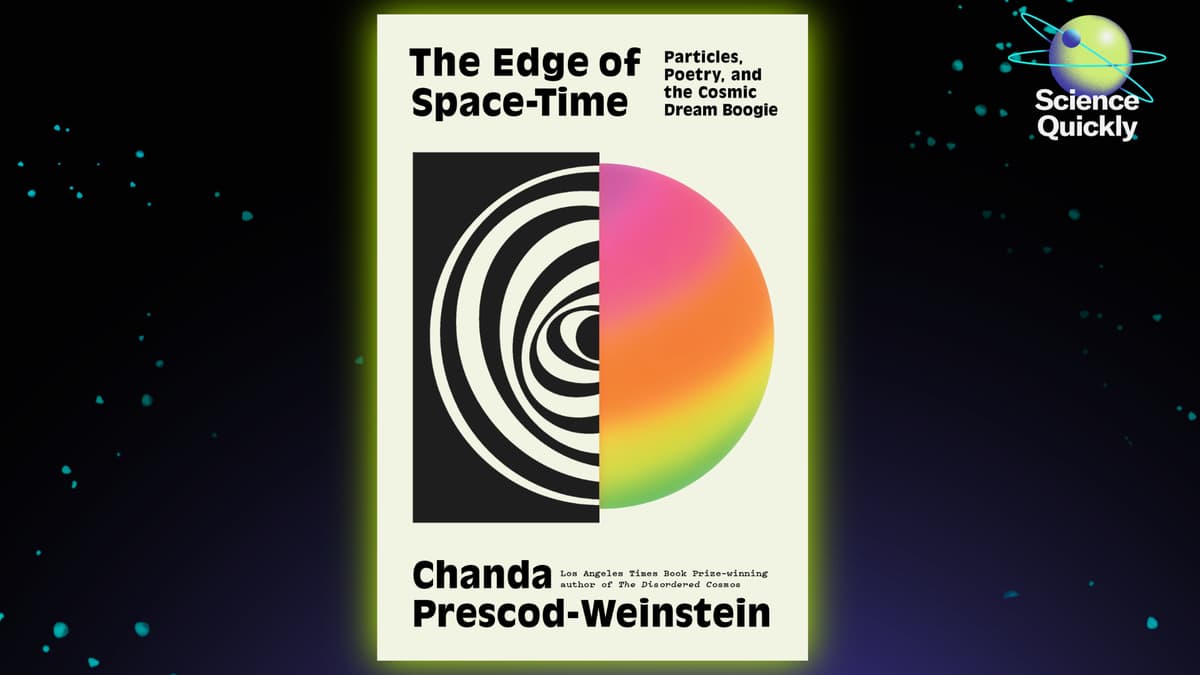
Chanda Prescod-Weinstein Connects Physics, Poetry and Pop Culture
Why It Matters
By framing physics through cultural and historical lenses, the book expands science communication, fostering broader public interest and encouraging more diverse voices in research.
Key Takeaways
- •Prescod‑Weinstein blends quantum physics with poetry and pop culture
- •Book highlights historic contributions like Mozi predating Newton
- •Star Trek serves as model for collaborative scientific community
- •Dark matter research linked to Vera Rubin Observatory and Roman Telescope
- •Queer‑of‑color theory informs her view of particle identities
Pulse Analysis
Chanda Prescod‑Weinstein’s *The Edge of Space‑Time* exemplifies a growing trend where scientists use narrative techniques to demystify abstract concepts. By weaving together quantum mechanics, cosmology, and queer‑of‑color theory, she demonstrates that physics is not isolated from the humanities but thrives on interdisciplinary dialogue. This approach resonates with educators seeking to make STEM curricula more inclusive, showing that pattern‑based thinking in poetry can mirror the search for symmetry in particle physics, and that cultural references can act as cognitive bridges for non‑specialists.
The book also tackles frontier research topics such as dark matter and cosmic acceleration, grounding them in personal anecdotes and upcoming observational assets. Prescod‑Weinstein cites the Vera C. Rubin Observatory, the Nancy Grace Roman Space Telescope, ESA’s Euclid, and JWST as critical tools that will refine galaxy‑scale measurements and potentially reveal the particle nature of dark matter, whether axions or other candidates. By linking these cutting‑edge experiments to historical figures like Mozi, she underscores the continuity of scientific inquiry across millennia, reminding readers that today’s breakthroughs stand on a global, multicultural foundation.
Beyond the science, the work challenges the cultural image of the physicist by foregrounding queer and Black diaspora perspectives. References to *Star TreK*, Missy Elliott, and Octavia Butler illustrate how pop culture can model a collaborative, equitable scientific community—one that values curiosity over competition. This narrative invites institutions to rethink hiring, mentorship, and outreach practices, positioning inclusive storytelling as a catalyst for both public engagement and the next generation of innovators. The book’s blend of rigorous physics with vibrant cultural commentary offers a template for future science communicators aiming to broaden the appeal and impact of their work.
Chanda Prescod-Weinstein connects physics, poetry and pop culture
Comments
Want to join the conversation?
Loading comments...