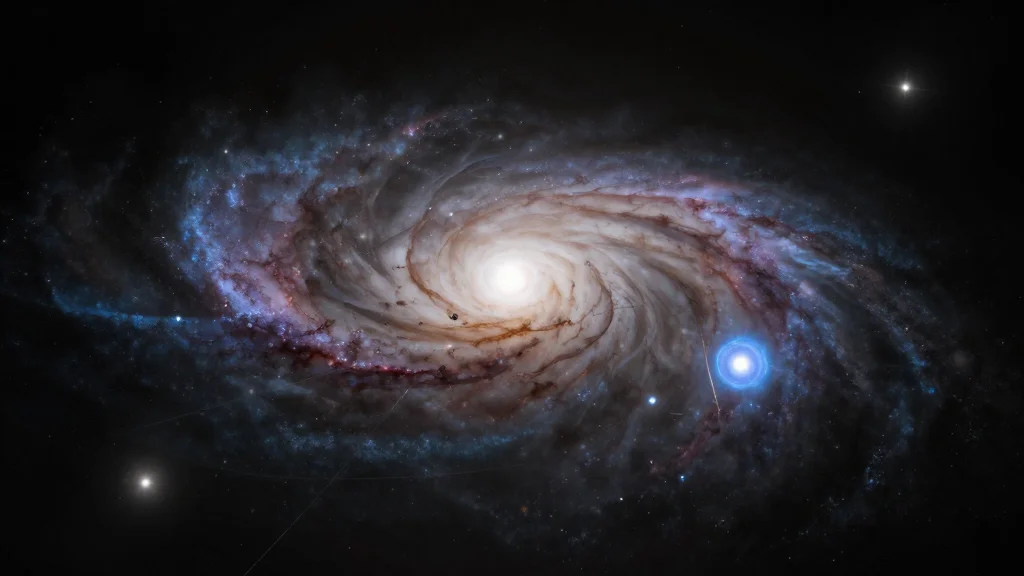
Chandra Reveals Flickering Supernova Remnants in M83 over 14 Years
Why It Matters
The discovery challenges the conventional view that supernova remnants fade uniformly, indicating a hidden population of variable high‑mass X‑ray binaries that can affect galaxy X‑ray emission models and our understanding of stellar evolution after supernovae.
Key Takeaways
- •Half of 22 X‑ray supernova remnants in M83 varied over 14 years.
- •Variability suggests many remnants host high‑mass X‑ray binaries.
- •SN 1957D’s flares caused by shock interaction with surrounding material.
- •Similar variable remnants found in star‑forming galaxy M51.
- •Findings imply a new class of X‑ray sources linked to supernova debris.
Pulse Analysis
The long‑term monitoring capability of NASA’s Chandra observatory has opened a window onto the dynamic lives of supernova remnants, objects traditionally thought to dim steadily after the initial explosion. By stacking observations from 2000 to 2014, astronomers were able to detect subtle yet dramatic X‑ray fluctuations in M83, a galaxy only 15 million light‑years away. This level of temporal resolution is rare for extragalactic remnants and underscores the value of sustained, high‑resolution X‑ray surveys for uncovering unexpected astrophysical behavior.
The variability pattern points to a surprising prevalence of high‑mass X‑ray binaries (HMXBs) embedded within what were previously catalogued as simple remnants. In these systems, a massive star survives the supernova that creates a neutron star or black hole, and the compact object then siphons material from its companion, producing bright, erratic X‑ray emission. Such accretion‑driven flares can mimic or amplify the remnant’s own shock‑heated glow, complicating traditional interpretations of supernova energetics. The identification of over twenty candidate HMXB‑linked remnants in a single galaxy reshapes estimates of binary formation rates in star‑burst environments.
Beyond M83, the detection of a similar variable population in M51 suggests that this phenomenon may be a common feature of actively star‑forming galaxies. Future missions like the European Athena observatory and NASA’s Lynx concept will benefit from these findings, prompting targeted monitoring campaigns to refine binary evolution models and improve X‑ray background predictions. For the broader scientific community, recognizing that supernova remnants can host hidden, high‑energy engines offers fresh avenues for probing stellar death, compact object demographics, and the feedback processes that shape galactic ecosystems.
Chandra reveals flickering supernova remnants in M83 over 14 years
Comments
Want to join the conversation?
Loading comments...