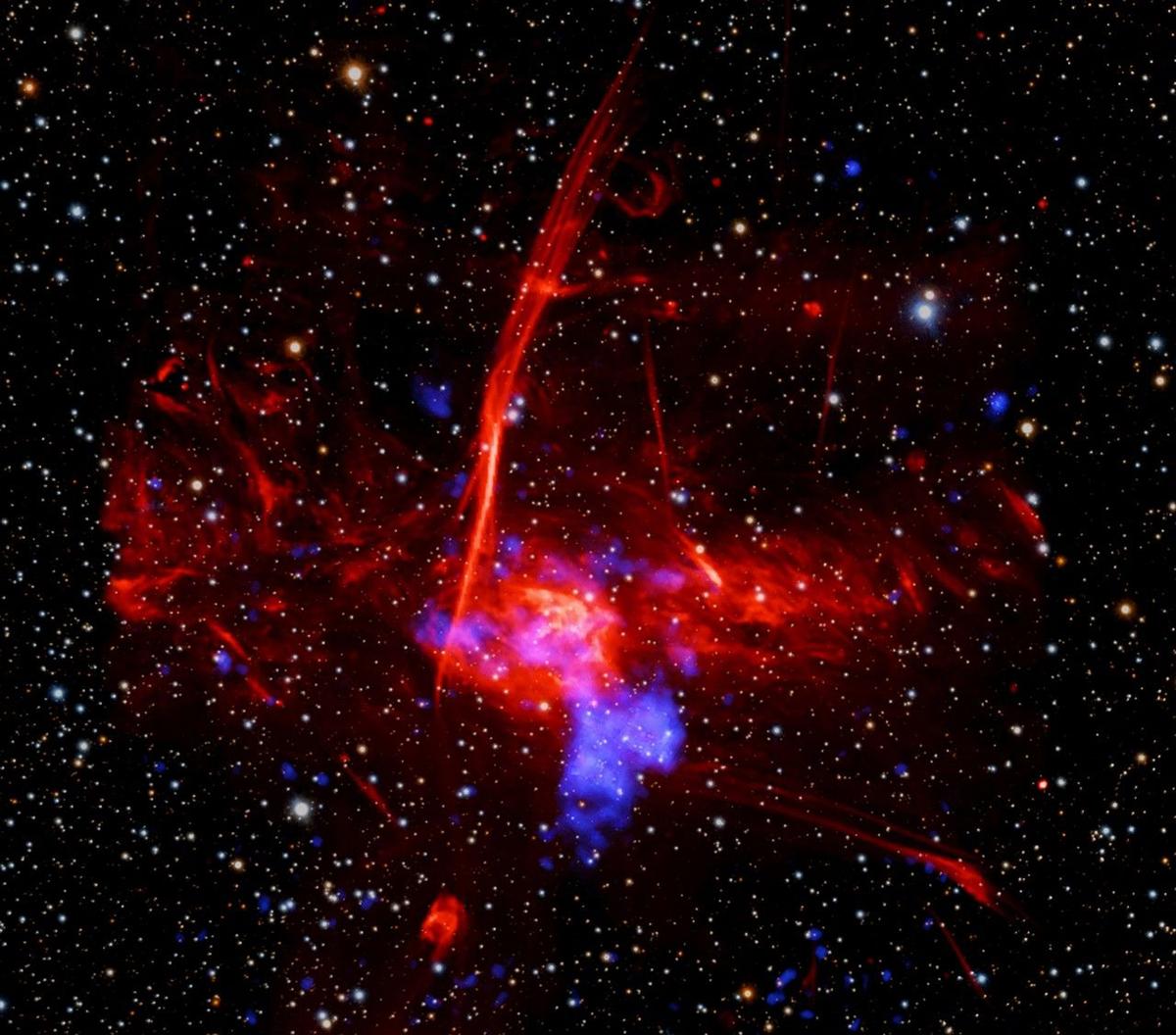
Chandra X-Ray Observatory Data Points To Supernova Near Galactic Center
Companies Mentioned
Why It Matters
Confirming a supernova remnant so close to the supermassive black hole would sharpen models of chemical enrichment and stellar life cycles in extreme environments, influencing how astronomers trace element distribution across the Milky Way.
Key Takeaways
- •Chandra data suggests a previously unknown supernova remnant near Milky Way’s core
- •Remnant could be among the closest to the central supermassive black hole
- •Confirmation requires additional X‑ray observations and multi‑wavelength follow‑up
- •Discovery may refine models of element distribution in dense galactic environments
Pulse Analysis
The Chandra X‑ray Observatory continues to prove its value for high‑energy astrophysics, capturing the faint, high‑temperature glow of shock‑heated plasma that signals a supernova remnant. By isolating characteristic X‑ray lines of iron, silicon and oxygen, astronomers can differentiate a true remnant from other energetic phenomena such as pulsar wind nebulae or accretion flows. This capability is especially critical in the Galactic Center, where dense gas clouds and intense magnetic fields obscure optical and infrared observations, making X‑ray data the most reliable window into recent stellar deaths.
The newly reported candidate lies within a few parsecs of Sagittarius A*, the Milky Way’s central supermassive black hole. Its proximity to this gravitational powerhouse suggests the progenitor star survived a hostile environment before exploding, offering a rare laboratory to study how supernova shock waves propagate through unusually dense interstellar media. The initial analysis points to a shell of hot gas expanding at several thousand kilometers per second, consistent with a few thousand‑year‑old remnant. However, the crowded field of X‑ray sources near the core demands corroborating evidence from radio, infrared and future X‑ray missions to rule out alternative explanations.
If subsequent observations confirm the remnant, the discovery will have far‑reaching implications for galactic chemical evolution. Supernovae are primary factories of heavy elements that seed future star and planet formation; locating one near the Galactic Center helps quantify how efficiently these metals mix into the central bulge. Moreover, the event provides a benchmark for simulations of stellar feedback in extreme gravitational potentials, informing theories that link black‑hole activity, star formation rates, and the overall energy budget of the inner Milky Way. Continued monitoring will thus enrich both observational catalogs and theoretical frameworks, underscoring the strategic importance of sustained X‑ray astronomy investments.
Chandra X-ray Observatory Data Points To Supernova Near Galactic Center
Comments
Want to join the conversation?
Loading comments...