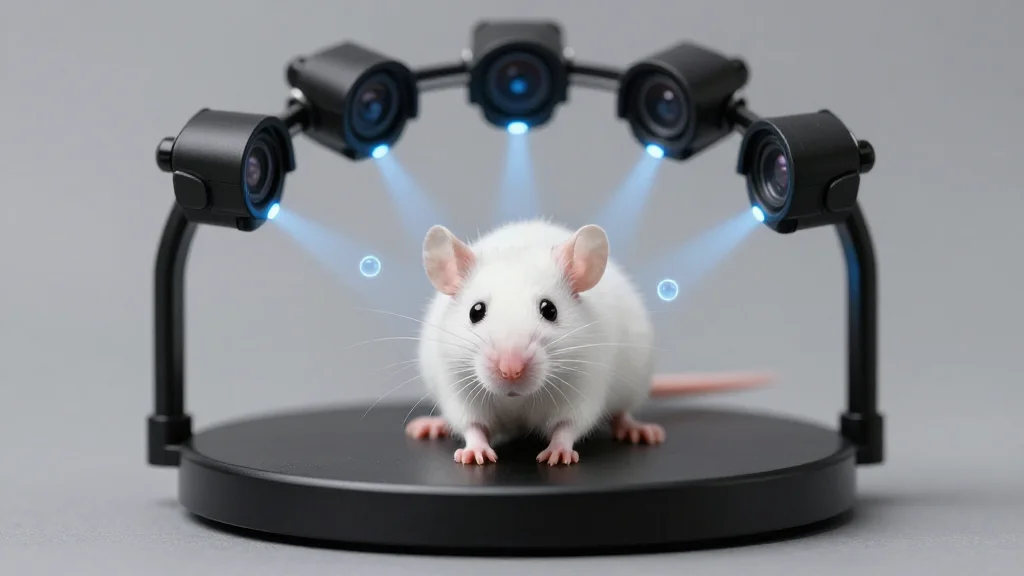
Cheese3D Enables Sensitive Detection and Analysis of Whole-Face Movement in Mice
Why It Matters
Cheese3D provides researchers with a precise, non‑invasive tool to monitor internal physiological states via facial motion, potentially replacing invasive electrophysiology in many neuroscience and drug‑development applications.
Key Takeaways
- •Cheese3D uses six high‑speed cameras to capture 3D facial data at 100 Hz.
- •System tracks 27 facial keypoints and extracts 17 geometric features for analysis.
- •3D triangulation cuts keypoint jitter, enabling detection of micrometer‑scale movements.
- •Facial features predict anesthesia recovery time as accurately as EEG power spectra.
- •Chewing dynamics and eye‑boggling are quantified non‑invasively, replacing EMG.
Pulse Analysis
The mouse face has long been recognized as a compact window into internal states, yet extracting quantitative, whole‑face information has been hampered by the animal’s tiny, three‑dimensional anatomy. Cheese3D overcomes these obstacles with a calibrated six‑camera rig that records at 100 Hz and reconstructs 27 facial keypoints in true 3D space. By converting raw video into 17 anatomically grounded geometric features—distances, angles, areas and volumes—the platform delivers millimeter‑level precision while preserving the temporal fidelity needed to follow rapid orofacial events.
The authors validated Cheese3D against a high‑resolution 3D scanner, showing sub‑50 µm agreement and demonstrating that omitting any camera pair degrades accuracy in specific regions. Crucially, 3D triangulation reduces keypoint jitter compared with 2D pipelines, allowing detection of movements as small as 2.6 µm. In proof‑of‑concept experiments, subtle whisker and ear motions during ketamine‑xylazine recovery predicted elapsed time with performance comparable to EEG power band models, and facial metrics explained up to 58 % of EEG theta variance. Chewing cycles and the so‑called “eye‑boggling” phenomenon were also captured without invasive electrodes.
By turning facial kinematics into a high‑bandwidth, non‑invasive biomarker, Cheese3D opens new avenues for neuroscience and drug discovery. Researchers can now link brainstem motor commands to precise facial outputs, monitor analgesic or anesthetic depth, and phenotype genetic models of neurological disease without surgery. The open‑source pipeline and interactive visualizer lower the barrier for adoption across labs, promising broader integration of facial readouts into behavioral phenotyping, longitudinal health monitoring, and closed‑loop neuromodulation studies.
Cheese3D enables sensitive detection and analysis of whole-face movement in mice
Comments
Want to join the conversation?
Loading comments...