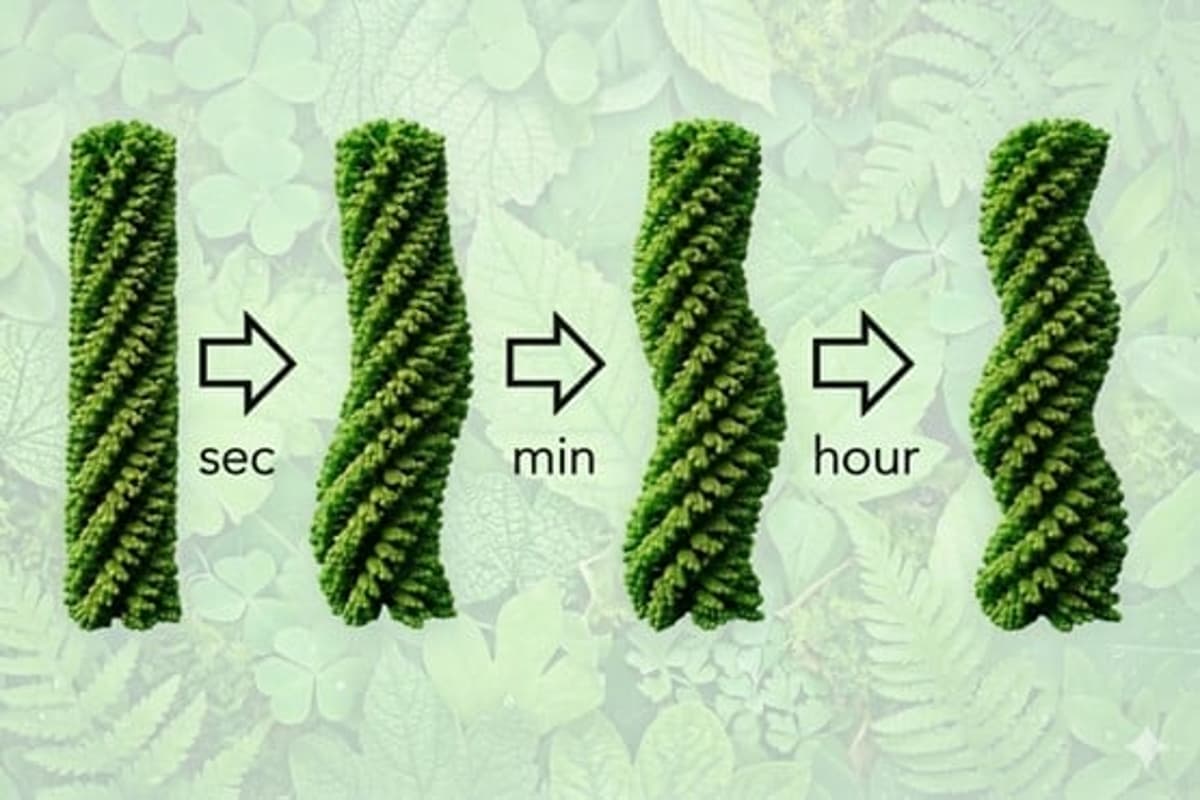
Chiba University Researchers Develop Chlorophyll Polymer That Evolves Helical Structure Over Time
Key Takeaways
- •Four polymer states: NF, HF1, HF2, HF3 with distinct pitches.
- •Helical transition occurs within minutes to days via cooperative propagation.
- •Chlorophyll derivative functionalized with barbituric acid and alkyl chains.
- •Enables design of adaptive materials that emulate biological structural dynamics.
Pulse Analysis
Supramolecular polymers that harness non‑covalent interactions have become a cornerstone of next‑generation materials, offering tunable architecture without permanent bonds. By integrating a chlorophyll scaffold functionalized with barbituric‑acid groups and long alkyl chains, the Chiba University team created a building block that self‑assembles into rosette‑like rings. These rings stack into one‑dimensional fibers, but the steric bulk of the chlorophyll core prevents immediate helicity, setting the stage for a time‑dependent reorganization that mimics the adaptive folding seen in DNA and proteins.
The researchers employed atomic force microscopy to capture four distinct structural states: a nonhelical fiber (NF) and three right‑handed helices (HF1, HF2, HF3) with progressively tighter pitches of 26 nm, 13 nm and 8 nm. Their time‑resolved imaging revealed a cascade—within 30 minutes NF converts to HF1 and HF2, HF1 then shifts almost entirely to HF2 over hours, and the final HF2‑to‑HF3 transition unfolds over several days. Crucially, the process is cooperative: a localized helical segment stabilizes neighboring regions, allowing the helicity to propagate along the polymer backbone, a behavior rarely observed in synthetic systems.
This discovery opens a pathway to materials that can change shape, optical activity, or mechanical properties on demand, simply by allowing time to act as a stimulus. Potential applications span self‑healing coatings that gradually reinforce after damage, photonic devices whose chirality can be tuned for circularly polarized light, and bio‑inspired scaffolds that adapt their geometry during tissue growth. As researchers explore directional initiation and external triggers, the ability to program kinetic pathways could become a strategic asset for industries seeking responsive, energy‑efficient solutions.
Chiba University Researchers Develop Chlorophyll Polymer That Evolves Helical Structure Over Time
Comments
Want to join the conversation?