Why It Matters
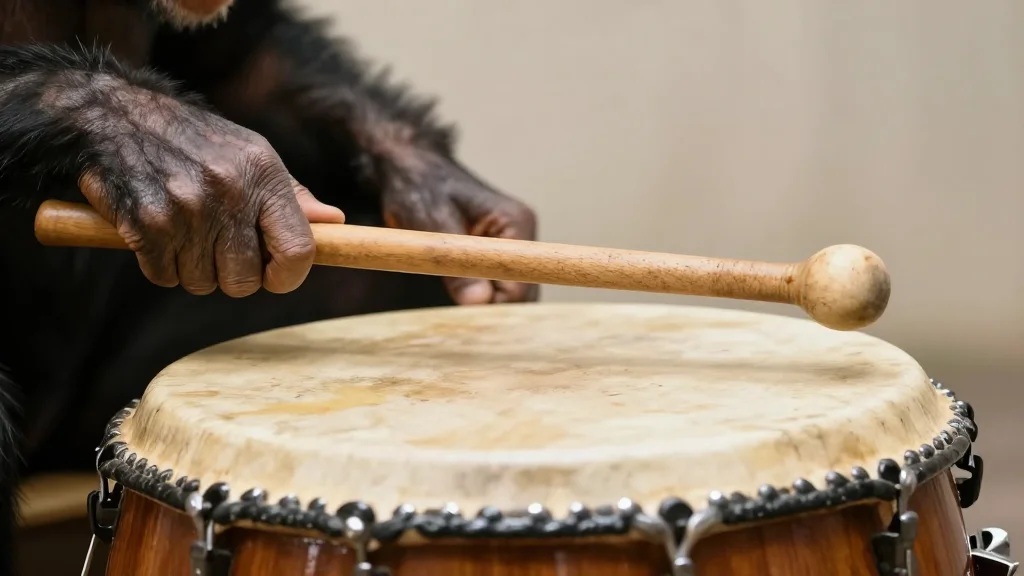
Ayumu’s music‑like behavior demonstrates that primates can externalize vocal emotions through instruments, offering concrete evidence for the evolutionary roots of human music. It reshapes theories on how rhythmic communication and tool use co‑evolved in our ancestors.
Key Takeaways
- •Ayumu performed 89 spontaneous drumming sessions.
- •Tool‑drummed rhythms showed isochronous, stable tempo.
- •Sequences mirrored chimp pant‑hoot structure.
- •Play‑face indicated positive emotional arousal.
- •Suggests vocal emotion externalized via instruments.
Pulse Analysis
Recent discoveries in primate cognition have repeatedly shown that great apes can synchronize movements, but the emergence of structured instrumental sound remains rare. Ayumu’s spontaneous drumming, captured over two years, adds a new dimension by coupling tool manipulation with rhythmic precision. Unlike trained performances, his displays arose without human prompting, highlighting innate capacities for temporal organization. This behavior bridges the gap between vocal communication—such as pant‑hoots—and the manipulation of external objects to produce music‑like patterns, offering a tangible analogue for early hominin experimentation.
The research team dissected each episode into discrete actions—striking, dragging, throwing—and applied transition analysis to separate chance occurrences from intentional sequencing. Isochronous intervals, comparable to a metronome, emerged especially when Ayumu employed floorboards as percussive tools, suggesting that the physical properties of objects can enhance rhythmic stability. Facial cues, notably the play‑face, signaled high arousal and positive affect, reinforcing the link between emotional states and sound production. These metrics provide quantitative evidence that non‑human primates can externalize affective vocalizations through learned motor patterns.
From an evolutionary perspective, Ayumu’s performances support the hypothesis that music may have originated as an extension of affect‑laden vocal calls, later refined by tool use. If early humans observed similar behaviors in ancestral primates, the transition to deliberate instrument making could have been a natural progression, facilitating group cohesion and social signaling. The study also opens avenues for comparative research across species, encouraging neuroscientists and anthropologists to explore the neural substrates of rhythm and emotion. Understanding this lineage enriches our grasp of why music remains a universal human trait.
Chimpanzee’s Drum Solo Offers Clues to Origins of Music
Comments
Want to join the conversation?
Loading comments...