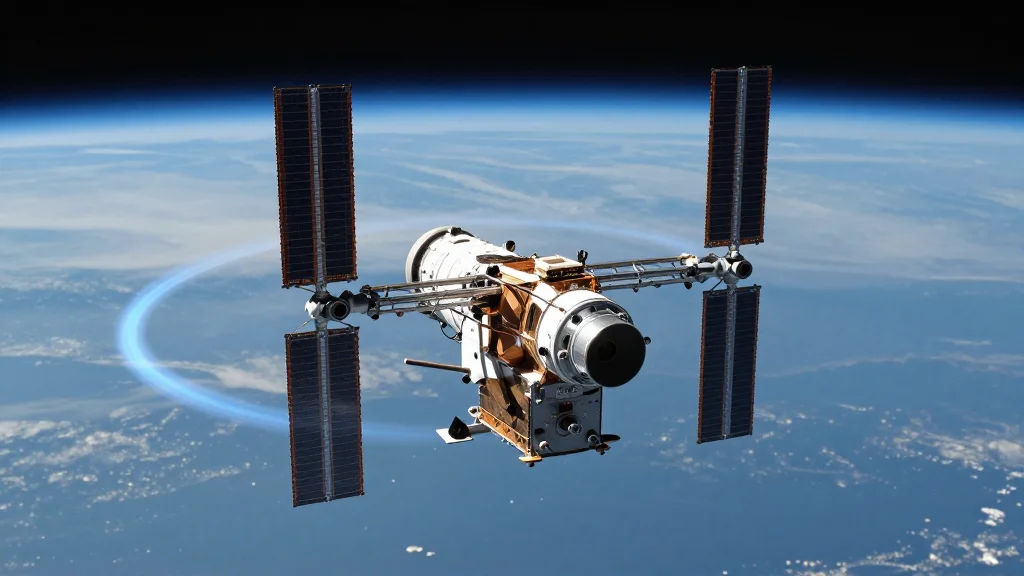
China's DAMPE Satellite Detects Charge‑Dependent Cosmic‑Ray Acceleration Limit

Why It Matters
The charge‑dependent acceleration limit reshapes our understanding of how cosmic rays achieve ultra‑high energies, a question that has persisted since the discovery of cosmic radiation. By pinpointing a nearby accelerator, the DAMPE results could guide future missions and ground‑based telescopes toward targeted observations, accelerating progress on the origin of cosmic rays and the role of dark matter in high‑energy astrophysics. Moreover, the success of DAMPE highlights China's expanding role in frontier space science, potentially shifting collaborative dynamics in the global research ecosystem. Beyond astrophysics, the discovery may influence particle‑physics models that rely on cosmic‑ray data to test theories beyond the Standard Model. A clearer picture of acceleration mechanisms will improve background estimates for dark‑matter searches, enhancing the sensitivity of both space‑borne and terrestrial detectors.
Key Takeaways
- •DAMPE reports first observational evidence of charge‑dependent cosmic‑ray acceleration limit
- •Study published in *Nature* based on 2016‑2024 data covering five particle types
- •Evidence supports existence of a nearby "super particle accelerator" ~1,000 light‑years away
- •Satellite has recorded ~18.5 billion high‑energy events over 10+ years in orbit
- •Findings could narrow candidate sources such as supernova remnants and pulsars
Pulse Analysis
DAMPE’s breakthrough arrives at a pivotal moment for high‑energy astrophysics. For years, the community has relied on indirect signatures—spectral knees, anisotropies, and multi‑messenger coincidences—to infer the nature of cosmic‑ray accelerators. By delivering a direct, charge‑specific cutoff, DAMPE provides a concrete metric that can be cross‑checked against models of shock acceleration, magnetic reconnection, and tidal disruption events. This empirical anchor will likely spur a wave of theoretical work revisiting the 1960s charge‑dependent hypothesis, now with a data‑driven foundation.
Comparatively, NASA’s Alpha Magnetic Spectrometer (AMS‑02) and Japan’s CALorimetric Electron Telescope (CALET) have delivered high‑precision spectra but have not reported a clear charge‑dependent ceiling. DAMPE’s unique combination of wide energy coverage and superior particle‑identification may have given it the edge needed to resolve the subtle spectral feature. The result underscores the strategic value of diversified detector designs and suggests that future missions—such as the planned Chinese High Energy Cosmic‑Ray Detector (HECRD) and the European Space Agency’s HERD—should prioritize charge resolution alongside energy reach.
Strategically, the discovery enhances China’s scientific stature. While the nation has demonstrated engineering prowess with lunar and Mars missions, DAMPE’s scientific impact positions China as a leader in fundamental physics research. This could attract greater international collaboration, especially from institutions seeking access to the satellite’s extensive data archive. In the longer term, the identification of a nearby accelerator may inform the design of next‑generation observatories, including ground‑based Cherenkov arrays and neutrino detectors, which could target the same region of the sky for complementary signals. The convergence of space‑based and terrestrial observations promises a more holistic view of the high‑energy universe.
China's DAMPE Satellite Detects Charge‑Dependent Cosmic‑Ray Acceleration Limit
Comments
Want to join the conversation?
Loading comments...