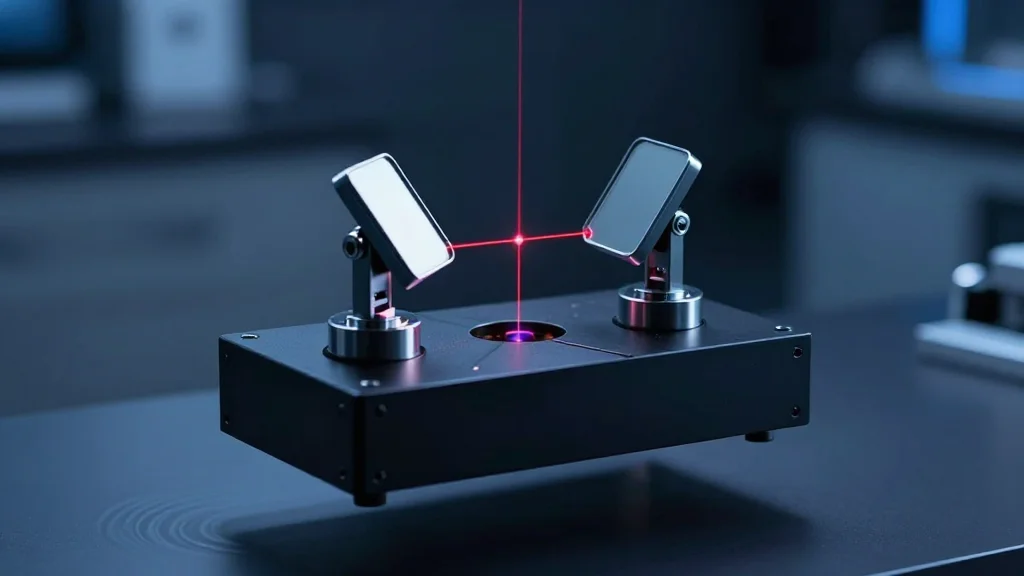
China's Taiji Program Debuts Picometer‑Precision Interferometer

Why It Matters
The ability to measure spacetime distortions at picometer precision expands humanity’s capacity to observe phenomena that were previously invisible, such as the inspiral of supermassive black holes in the early universe. By delivering a key subsystem that satisfies the demanding specifications of the Taiji‑2 mission, China moves closer to establishing a permanent, space‑based gravitational‑wave observatory that can operate alongside LISA and ground‑based detectors, creating a more complete frequency coverage. Beyond pure science, the technological advances in ultra‑stable optics, thermal control, and precision metrology have spill‑over potential for other high‑accuracy applications, including satellite navigation, Earth observation, and quantum communication. The breakthrough therefore represents both a scientific milestone and a catalyst for broader innovation in aerospace engineering.
Key Takeaways
- •Chinese team designs full‑function interferometer optical bench with picometer‑level accuracy
- •Noise level reduced and measurement stability enhanced tenfold, meeting Taiji‑2 requirements
- •Bench can detect displacement equivalent to 0.01 % of a human hair’s diameter
- •Findings published in the journal *Research*; prototype tested on ground with successful calibration
- •Taiji‑2, slated for mid‑2020s launch, will incorporate the new optical bench as a core component
Pulse Analysis
China’s recent optical‑bench breakthrough signals a decisive shift in the balance of capabilities for space‑based gravitational‑wave detection. Historically, the United States and Europe have dominated the field, with LIGO’s success and ESA’s LISA program setting the benchmark. Taiji’s rapid progress, highlighted by the picometer‑precision bench, demonstrates that China can now field technology that rivals its Western counterparts, potentially reshaping collaborative frameworks and data‑sharing agreements.
The technical achievement also reflects a broader trend of national space agencies leveraging domestic research institutions to accelerate high‑risk, high‑reward projects. By integrating the bench into Taiji‑2, China not only validates its engineering pipeline but also creates a platform for future upgrades, such as larger arm lengths or more sophisticated laser systems. This incremental approach mirrors the phased development of LISA, suggesting that a multi‑mission roadmap may become the norm for gravitational‑wave observatories.
Looking forward, the success of Taiji‑2 will hinge on the transition from ground testing to the space environment. If the optical bench performs as expected, it could pave the way for a full Taiji constellation that offers continuous, all‑sky coverage at low frequencies. Such a network would dramatically increase detection rates, enrich astrophysical catalogs, and enable cross‑validation of events observed by LISA and terrestrial detectors. The coming decade may thus witness a collaborative, multi‑platform era in gravitational‑wave astronomy, with China emerging as a central player.
China's Taiji Program Debuts Picometer‑Precision Interferometer
Comments
Want to join the conversation?
Loading comments...