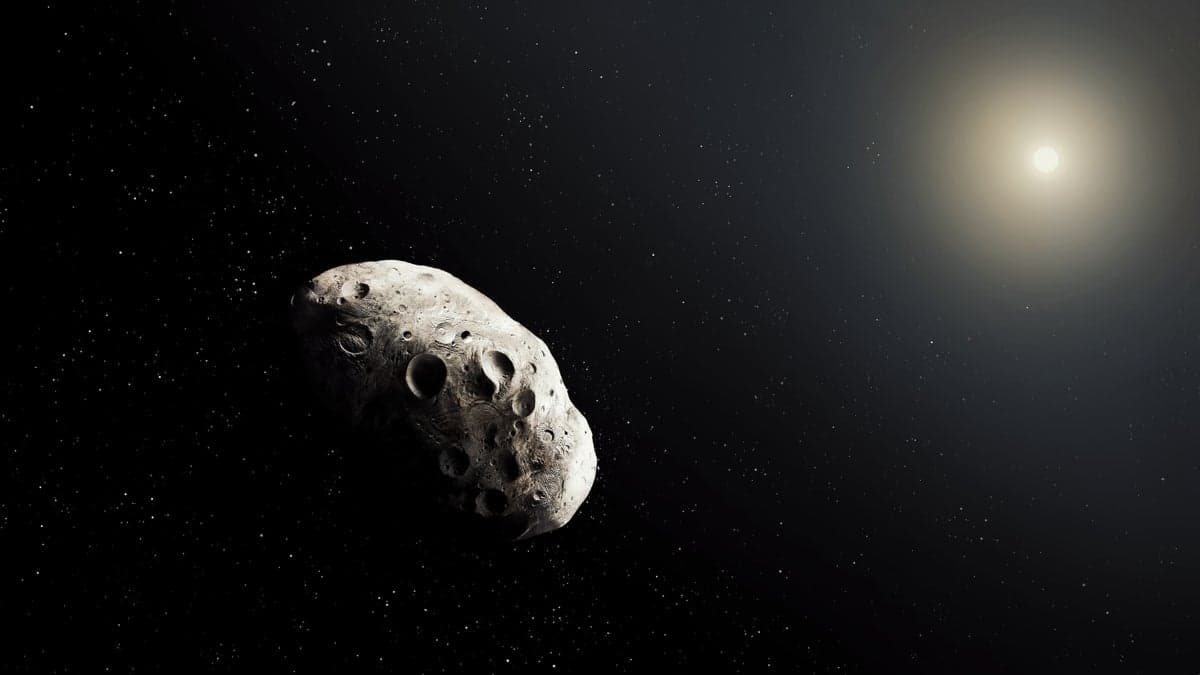
China’s Tianwen-2 Spacecraft Arrives at One of Earth’s Mysterious ‘Quasi-Moons’
Why It Matters
The mission could resolve the asteroid’s origin—lunar fragment or main‑belt—while cementing China’s capability to conduct autonomous deep‑space sample returns, a strategic milestone in the competitive space arena.
Key Takeaways
- •Tianwen‑2 reached asteroid Kamoʻoalewa after precise engine burn.
- •Asteroid spins every 28 minutes, 40‑100 m diameter.
- •Mission will test three sampling methods on fast‑rotating body.
- •Samples could confirm lunar fragment or main‑belt origin.
- •Success boosts China’s autonomous deep‑space and future Mars plans.
Pulse Analysis
The asteroid Kamoʻoalewa, one of only seven known Earth quasi‑moons, follows a co‑orbital path that keeps it near our planet while looping retrograde around the Sun. Measuring roughly 40 to 100 metres and completing a full spin in just 28 minutes, it presents a uniquely challenging target for close‑up observation. China’s Tianwen‑2, the nation’s second deep‑space probe, executed a precision engine burn over the weekend to enter the asteroid’s vicinity, marking the first time a Chinese spacecraft has approached a quasi‑moon.
The mission’s design incorporates three distinct sampling strategies—touch‑and‑go, hover, and anchor‑and‑attach—to cope with the rapid rotation and uncertain surface cohesion. By relying on onboard cameras, lidar and radar, Tianwen‑2 can autonomously navigate within 20 km of Kamoʻoalewa, a capability that mirrors the precision demonstrated by Japan’s Hayabusa2 and NASA’s OSIRIS‑REx but pushes it further with real‑time decision‑making. The planned July‑4 close approach will test these methods, and a successful sample return in November 2027 would place China alongside the United States and Japan in asteroid‑return capability.
Beyond engineering, the retrieved material could settle a long‑standing debate over the asteroid’s provenance. If isotopic signatures match lunar rocks, the hypothesis that Kamoʻoalewa is a fragment ejected by the Giordano Bruno impact will gain strong support, reshaping models of lunar ejecta dynamics. Conversely, a main‑belt composition would highlight the role of space weathering in producing moon‑like spectra. Either outcome not only advances planetary science but also demonstrates China’s growing autonomy in deep‑space exploration, paving the way for future Mars sample‑return and comet missions.
China’s Tianwen-2 spacecraft arrives at one of Earth’s mysterious ‘quasi-moons’
Comments
Want to join the conversation?
Loading comments...