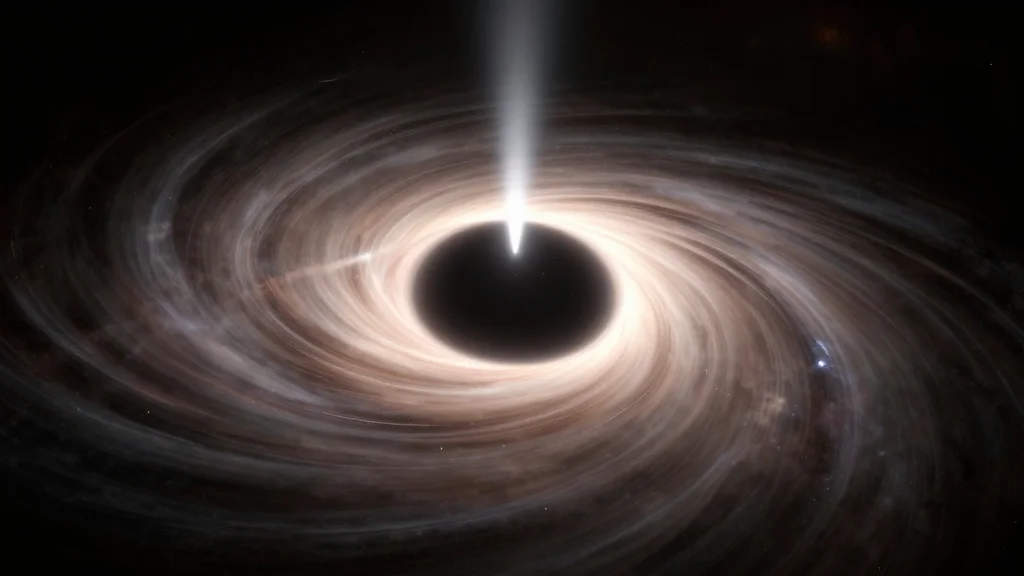
Chinese Astronomers Spot 20‑Day ‘Heartbeat’ From Black Hole, Validating Einstein

Why It Matters
Confirming frame‑dragging around a black hole bridges a century‑old theoretical prediction with concrete astronomical data, strengthening confidence in General Relativity under the most extreme conditions. The ability to measure black‑hole spin through periodic disk‑jet signals opens a new observational window, enabling scientists to test models of jet formation, energy extraction, and galaxy evolution. Moreover, the success of multi‑wavelength coordination underscores the importance of collaborative, rapid‑response astronomy in capturing transient phenomena that can reshape our understanding of the cosmos. Beyond pure physics, the finding may influence how future space missions prioritize instrumentation. Demonstrating that X‑ray and radio timing can jointly reveal relativistic effects could drive the development of synchronized observation networks, ensuring that the next generation of telescopes can exploit these signatures to map black‑hole populations across cosmic time.
Key Takeaways
- •Chinese Academy of Sciences team detects a 20‑day periodic signal from tidal‑disruption event AT2020afhd.
- •Signal observed in both X‑ray (Swift) and radio (VLA) wavelengths, showing disk‑jet co‑precession.
- •Discovery provides direct evidence of Einstein’s frame‑dragging around a rapidly spinning black hole.
- •Event occurred in a galaxy ~120 million light‑years from Earth after a star was torn apart.
- •Future work will target additional tidal‑disruption events to build a statistical sample of black‑hole spins.
Pulse Analysis
The AT2020afhd heartbeat marks a watershed for observational relativity. While frame‑dragging has been inferred from the orbits of stars near the Milky Way’s central black hole, this is the first time a clean, periodic signature has been captured in the emission from a transient event. The result validates decades of theoretical work on how a black hole’s spin can couple to its surrounding accretion flow, turning a subtle curvature of spacetime into a macroscopic wobble that telescopes can track.
Historically, black‑hole spin has been one of the hardest parameters to measure, relying on indirect methods such as fitting X‑ray reflection spectra or modeling jet power. The periodicity observed here offers a complementary, timing‑based approach that could be less model‑dependent. If the community can replicate the technique across a broader sample, it may finally enable a population‑level census of spin, shedding light on how black holes grow—whether through steady accretion or chaotic mergers.
Looking ahead, the discovery dovetails with upcoming facilities. The Athena X‑ray observatory, slated for the early 2030s, will deliver unprecedented spectral resolution, while the Square Kilometre Array will provide radio sensitivity orders of magnitude higher than today. Together, they could capture even fainter precessional signals, extending the method to more distant galaxies and earlier cosmic epochs. In that sense, the 20‑day heartbeat is not just a confirmation of Einstein; it is a prototype for a new class of black‑hole diagnostics that will shape astrophysics for decades.
Chinese Astronomers Spot 20‑Day ‘Heartbeat’ from Black Hole, Validating Einstein
Comments
Want to join the conversation?
Loading comments...