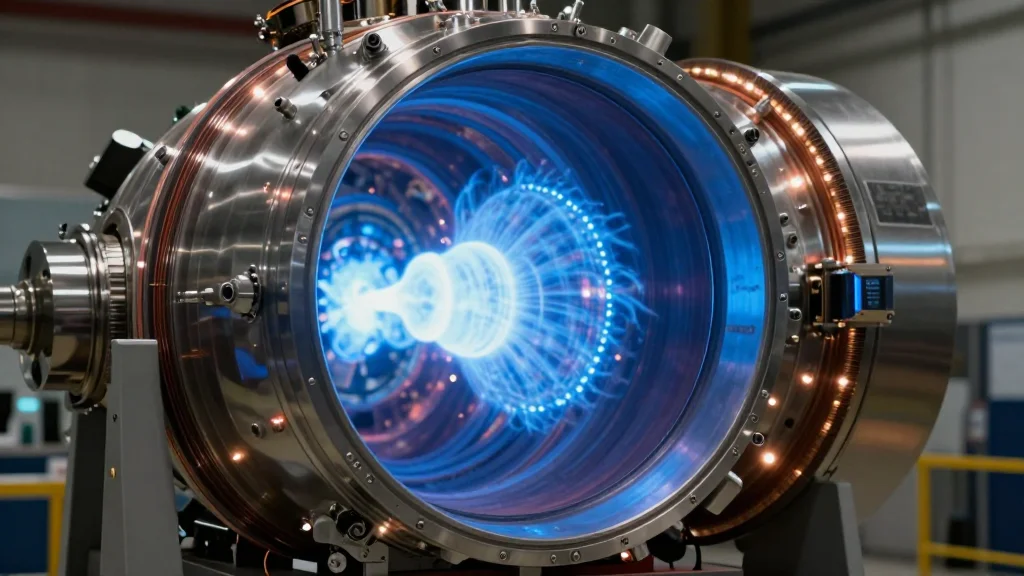
Chinese Team Demonstrates Dual Fusion Breakthrough on EAST Tokamak

Companies Mentioned
Why It Matters
The dual breakthrough tackles the long‑standing trade‑off between protecting reactor components and preserving the high confinement needed for net energy gain. By showing that divertor heat flux can be reduced without degrading plasma performance, the work opens a realistic route to longer pulse lengths and higher duty cycles, essential for commercial viability. Moreover, the technique leverages impurity seeding—a relatively low‑cost, controllable method—making it attractive for both large international projects like ITER and smaller private ventures seeking rapid commercialization. Beyond engineering, the result reshapes scientific priorities. Researchers can now allocate more resources to optimizing plasma core conditions, knowing that edge‑heat management is less of a bottleneck. This could accelerate progress toward achieving the "triple product" target (density × temperature × confinement time) that defines a breakeven fusion reactor, bringing the promise of carbon‑free baseload power closer to reality.
Key Takeaways
- •Prof. Guosheng Xu's team created the DTP regime on the EAST tokamak, sustaining it for ~1 minute.
- •The regime achieved partial divertor detachment, cutting heat flux to reactor walls.
- •Edge‑localized modes (ELMs) were fully suppressed without sacrificing confinement.
- •Results published in Physical Review Letters suggest a scalable solution for ITER and private reactors.
- •Follow‑up experiments planned for later 2026 to test longer pulses and higher currents.
Pulse Analysis
The Chinese achievement arrives at a pivotal moment for fusion development. ITER, slated for first plasma in 2028, still grapples with divertor heat‑load predictions that could limit its operational window. The DTP approach offers a pragmatic mitigation strategy that does not require radical redesign of the divertor geometry, potentially easing ITER’s engineering schedule. For the private sector, where capital efficiency is paramount, the ability to control edge conditions with impurity gases could lower the cost per megawatt of fusion power, making compact high‑field concepts more competitive.
Historically, fusion research has oscillated between focusing on core plasma performance and addressing material limits at the edge. This breakthrough re‑balances that equation, suggesting that future reactor designs may adopt a more integrated control system that dynamically adjusts impurity seeding in response to real‑time heat‑flux measurements. Such adaptive control could become a standard feature in next‑generation tokamaks, reducing the need for over‑engineered, expensive divertor components.
Looking ahead, the key challenge will be scaling the DTP regime from a minute‑long experiment to the multi‑second or minute‑scale pulses required for a power plant. If subsequent tests confirm that the regime remains stable under higher currents and longer durations, it could redefine the roadmap for commercial fusion, compressing the timeline that many analysts have projected at a decade or more. The international community will be watching closely, as the technique may become a shared tool across the global fusion ecosystem.
Chinese Team Demonstrates Dual Fusion Breakthrough on EAST Tokamak
Comments
Want to join the conversation?
Loading comments...