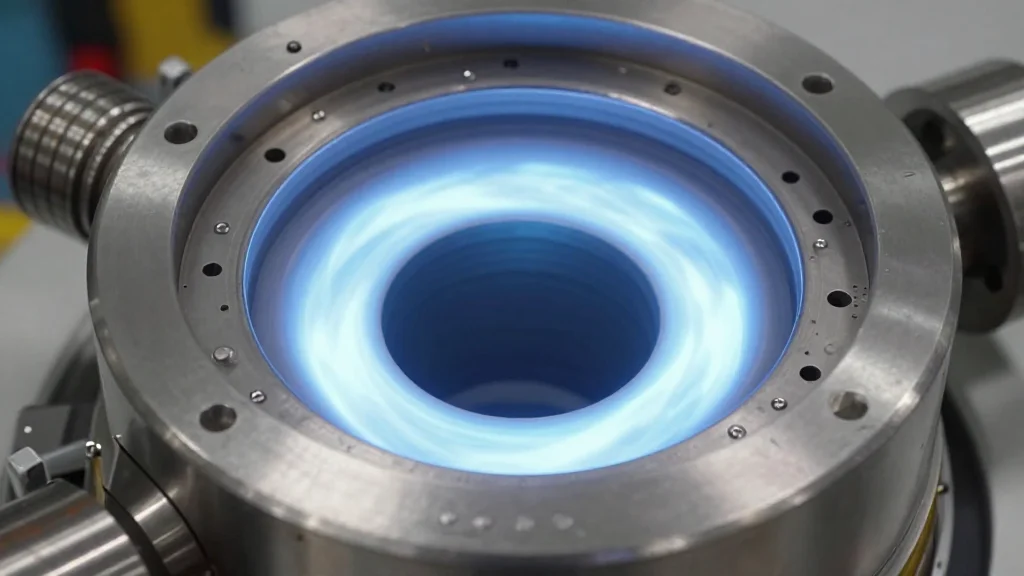
Chinese Team Sustains Tokamak Plasma for Over One Minute, a Fusion Milestone

Why It Matters
Sustaining plasma for over a minute while simultaneously solving the divertor heat‑load and ELM challenges addresses two of the most critical engineering hurdles in tokamak fusion. By demonstrating a controllable regime that balances high confinement with thermal protection, the experiment narrows the gap between experimental physics and practical reactor design. The result could accelerate investment in fusion projects worldwide, influencing policy decisions and private‑sector funding aimed at achieving carbon‑free energy. Beyond energy, the breakthrough informs broader high‑temperature plasma research, including astrophysical modeling and advanced materials testing under extreme conditions. The techniques developed for real‑time impurity‑gas control may also find applications in plasma processing industries, where precise thermal management is essential.
Key Takeaways
- •Chinese team led by Prof. Xu Guosheng sustained plasma >1 minute in EAST tokamak.
- •New DTP regime achieved partial divertor separation, H‑mode without ELMs, and high pedestal temperature.
- •Real‑time impurity‑gas injection reduced divertor heat flux while preserving plasma stability.
- •Result offers a potential solution to the long‑standing divertor‑heat‑load vs. confinement trade‑off.
- •Next milestones include multi‑minute pulses and scaling to higher power reactors like CFETR.
Pulse Analysis
The EAST achievement reshapes the fusion roadmap by proving that divertor heat management does not have to come at the expense of plasma performance. Historically, tokamak designs have toggled between aggressive confinement—risking damaging ELMs—and conservative operation that protects the divertor but limits fusion gain. The DTP regime sidesteps this binary by using impurity‑gas seeding as a dynamic control knob, a concept that could be retrofitted to existing machines with relatively modest hardware upgrades.
From a market perspective, the breakthrough reduces one of the biggest cost drivers for commercial fusion: the need for heavily shielded, replaceable divertor components. If reactors can run longer pulses without frequent component swaps, the levelized cost of electricity from fusion could drop substantially, making it more competitive with solar and wind. Investors watching the sector will likely view the result as a de‑risking factor, potentially unlocking new rounds of private capital for projects that incorporate similar divertor strategies.
Looking ahead, the key test will be whether the DTP regime scales to the megawatt‑level power densities envisioned for DEMO‑class reactors. Success will depend on integrating the gas‑control system with advanced superconducting magnets and high‑power heating schemes. International collaboration will be essential; sharing diagnostic data and control algorithms can accelerate validation across different tokamak platforms. If the regime proves robust, it could become a standard operating mode for the next generation of fusion power plants, turning the long‑standing promise of fusion energy into a practical reality.
Chinese Team Sustains Tokamak Plasma for Over One Minute, a Fusion Milestone
Comments
Want to join the conversation?
Loading comments...