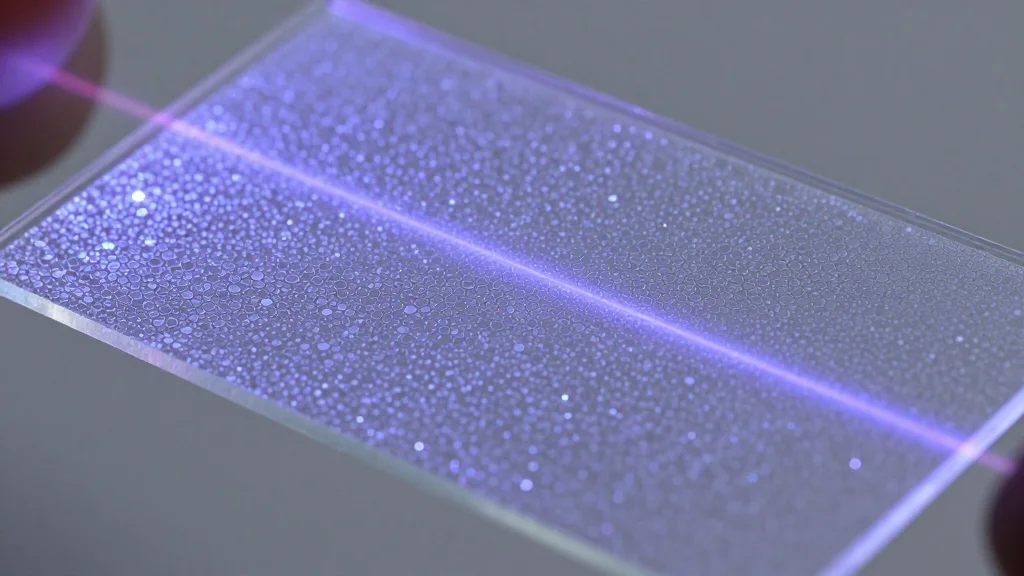
Chiral Lead‐Free Hybrid Organic‐Metal Halides for Thermally Switchable Nonlinear Optics (Small 19/2026)
Why It Matters
The technology delivers sustainable, high‑performance nonlinear optics, enabling dynamic photonic components without toxic lead. Its compatibility with existing chip manufacturing accelerates adoption in next‑generation optical systems.
Key Takeaways
- •Lead-free HOMHs enable safe nonlinear optical devices
- •Drop-casting yields orientation-controlled microplates with high SHG
- •Thermally reversible SHG allows dynamic photonic switching
- •Materials compatible with chip-scale integration
- •Expands eco-friendly NLO material library
Pulse Analysis
Nonlinear optical (NLO) materials are the backbone of frequency conversion, ultrafast modulation, and quantum photonics. Traditional NLO crystals often rely on lead‑based perovskites, raising environmental and health concerns. The emergence of chiral, lead‑free hybrid organic‑metal halides offers a greener alternative while preserving the strong second‑order susceptibility needed for efficient second‑harmonic generation. Their chiral architecture also introduces unique polarization control, expanding design flexibility for advanced photonic architectures.
The research team’s solvent‑assisted drop‑casting approach leverages surface‑energy gradients to direct crystal nucleation and growth, producing microplates with uniform orientation across the substrate. This precise control translates into consistent SHG output and, crucially, a thermally induced reversible switching mechanism. By simply adjusting temperature, the material toggles between high‑SHG and low‑SHG states, providing a straightforward, low‑energy method for dynamic optical modulation. Such thermal tunability circumvents the need for complex electrical gating or mechanical actuation, simplifying device architecture.
From a commercial perspective, these HOMHs align with the semiconductor industry's push toward sustainable, scalable components. Their compatibility with standard chip‑fabrication processes means they can be embedded directly into photonic integrated circuits, enabling on‑chip frequency doubling, optical signal processing, and reconfigurable light routing. As data centers and telecom networks demand higher bandwidth and lower power consumption, the ability to switch nonlinear responses thermally offers a compelling route to adaptive optics. Continued development could see these materials underpinning next‑generation LiDAR, quantum communication, and ultrafast laser systems, marrying performance with environmental responsibility.
Chiral Lead‐Free Hybrid Organic‐Metal Halides for Thermally Switchable Nonlinear Optics (Small 19/2026)
Comments
Want to join the conversation?
Loading comments...