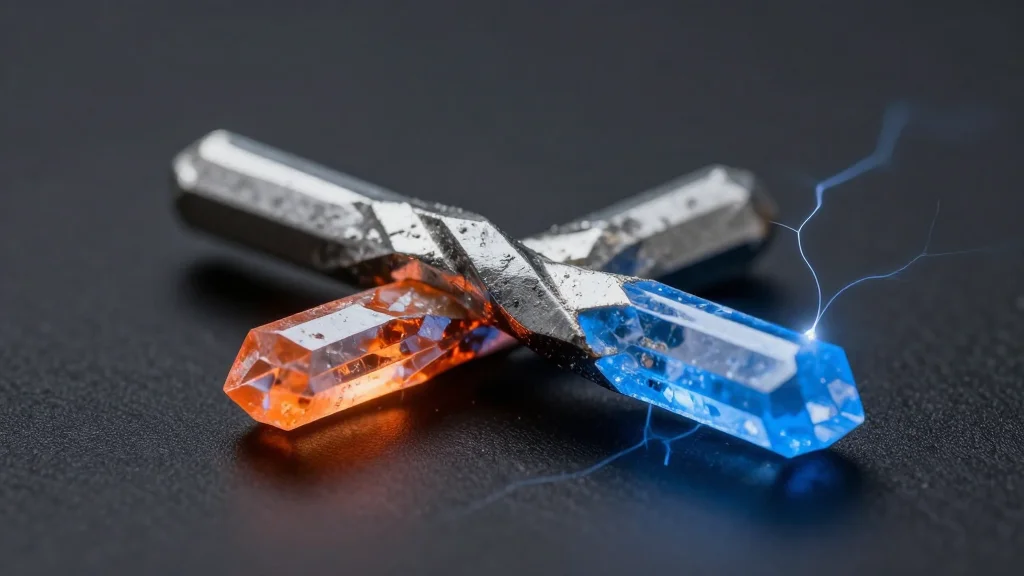
Chiral Tellurium Exhibits Unprecedented Nonlinear Thermoelectric Effect, Confirming Theory

Why It Matters
Confirming the chiral nonlinear thermoelectric effect moves a speculative concept into the realm of experimental physics, opening a pathway for materials scientists to design devices that exploit directional heat‑to‑electric conversion. This could reshape strategies for waste‑heat recovery in electronics, aerospace, and renewable‑energy systems, where efficient, compact converters are in high demand. Additionally, the ability to probe quantum geometry directly may accelerate the discovery of new topological phases, influencing both fundamental research and next‑generation quantum technologies. Beyond energy applications, the finding underscores the importance of crystal symmetry in governing transport phenomena. By demonstrating that chirality can produce measurable, controllable electrical signals from thermal gradients, the work encourages a broader search for symmetry‑driven functionalities in other low‑dimensional and layered materials.
Key Takeaways
- •RIKEN researchers observed a nonlinear thermoelectric effect in chiral tellurium.
- •The effect generates a voltage perpendicular to both temperature gradient and electric field.
- •Findings published in *Nature Physics* confirm theoretical predictions from prior studies.
- •Potential applications include directional heat management and waste‑heat energy harvesting.
- •The phenomenon offers a new experimental probe of quantum geometric properties.
Pulse Analysis
The experimental verification of a chiral nonlinear thermoelectric response marks a turning point for the field of quantum materials. Historically, thermoelectric research has focused on linear relationships, where doubling voltage doubles heat flow. The emergence of a third‑direction voltage signal, contingent on crystal chirality, suggests that symmetry can be leveraged to break conventional transport limits. This aligns with a broader trend where researchers exploit Berry curvature and related quantum geometric concepts to engineer unconventional electronic responses.
From a market perspective, the ability to convert random thermal fluctuations into directed electrical power could disrupt sectors reliant on low‑grade waste heat, such as data centers and automotive exhaust systems. While the current demonstration remains at the crystal‑scale, the underlying physics is scalable in principle. Companies investing in advanced thermoelectric modules may soon consider chiral materials as a differentiator, prompting a wave of patents and collaborations between academia and industry.
Looking ahead, the key challenge will be material synthesis and device integration. Maintaining chirality over large areas and under operational stresses is non‑trivial, and the sensitivity of the effect to precise field orientations may demand novel engineering solutions. Nonetheless, the RIKEN team's success provides a clear experimental blueprint. As more groups replicate and extend the work, we can expect a rapid expansion of the design space for energy‑conversion technologies, potentially reshaping how we harvest and manage heat in the next decade.
Chiral Tellurium Exhibits Unprecedented Nonlinear Thermoelectric Effect, Confirming Theory
Comments
Want to join the conversation?
Loading comments...