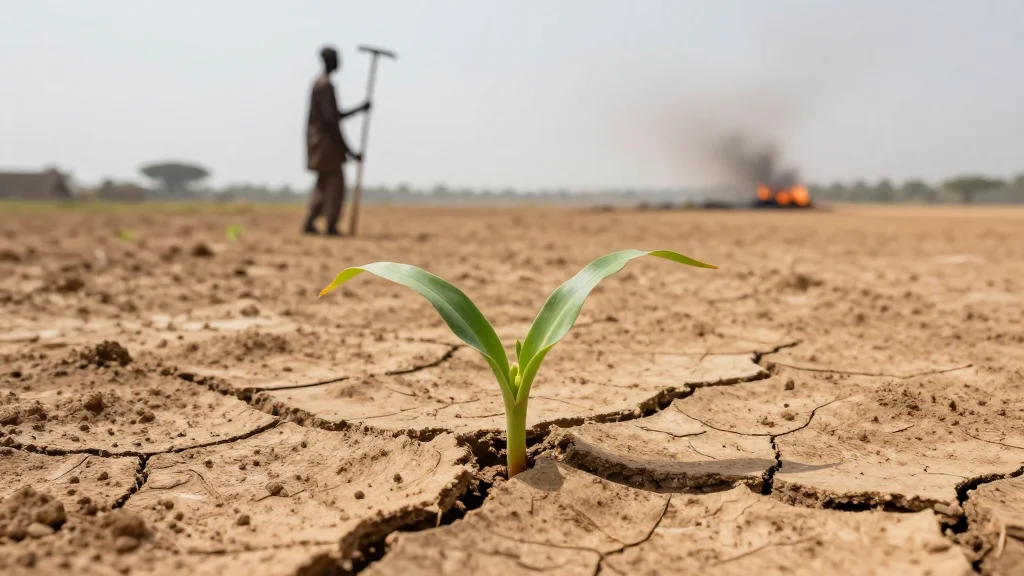
Climate Change, Natural Resource Conflicts and Insecurity in Nigeria: Implication for Food Security
Companies Mentioned
Why It Matters
The findings expose how intertwined climate volatility and insecurity threaten Nigeria’s staple food system, jeopardizing economic stability and regional resilience.
Key Takeaways
- •Flooding identified as most damaging climate shock to Nigerian farms
- •Insecurity-driven farmer‑herder clashes cut agricultural output sharply
- •Household asset ownership boosts resilience against climate‑conflict shocks
- •Integrated climate‑adaptation and conflict‑sensitive policies needed for food security
Pulse Analysis
Nigeria’s economy remains heavily anchored in rain‑fed agriculture, making it acutely vulnerable to climate variability. The study draws on two of the nation’s most comprehensive data sets—the 2018/19 General Household Survey and the 2022 National Agricultural Sample Census—to map how erratic rainfall, rising temperatures and extreme flooding intersect with escalating farmer‑herder tensions. By employing econometric techniques such as OLS, ordered logit and probit, the researchers isolate the direct contribution of climate‑related shocks and insecurity to reduced crop yields and livestock productivity, underscoring a clear causal pathway to household food insecurity.
The analysis reveals that flooding is the most destructive climate event, eroding arable land and displacing farming communities. Simultaneously, insecurity—manifested in banditry, kidnappings and protracted farmer‑herder conflicts—has led to the abandonment of farmlands, loss of labor, and destruction of assets. Households possessing tangible assets, such as livestock or equipment, demonstrate greater resilience, cushioning the shock of both environmental and security disruptions. These dynamics echo broader regional estimates that climate change could shave up to 3% off Africa’s GDP annually by 2030, with Nigeria bearing a disproportionate share due to its reliance on agriculture for livelihoods and food supply.
Policy implications are stark: fragmented responses that address climate adaptation or security in isolation will fall short. The authors advocate for a coordinated strategy that blends climate‑smart agriculture, robust natural‑resource governance, and conflict‑sensitive interventions—potentially leveraging digital platforms for early warning and dispute resolution. Such an integrated approach not only safeguards food availability but also stabilizes prices, supports rural incomes, and contributes to Nigeria’s broader development goals, including the Sustainable Development Goal of zero hunger by 2030.
Climate change, natural resource conflicts and insecurity in Nigeria: implication for food security
Comments
Want to join the conversation?
Loading comments...