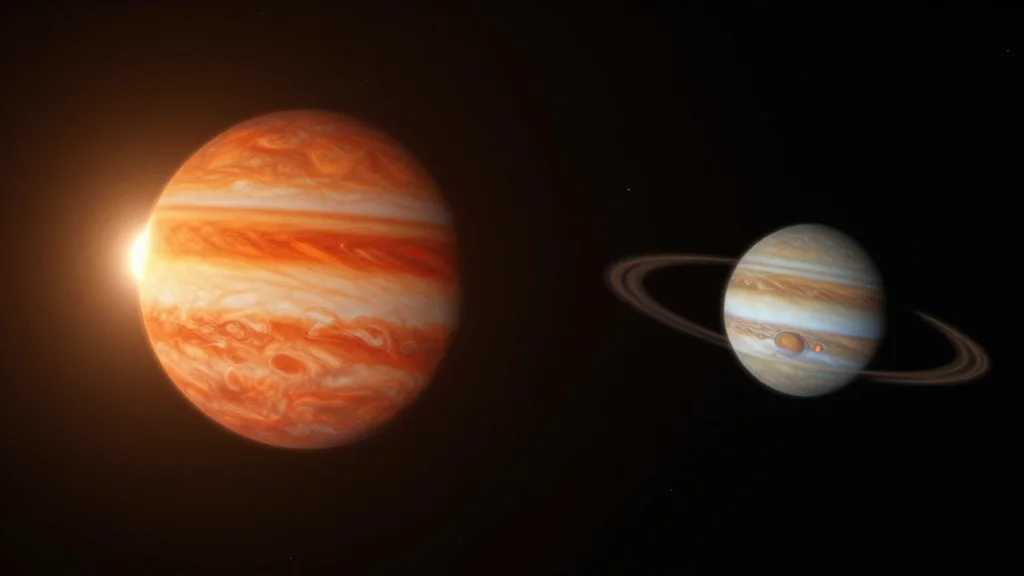
Close-In Planets Act as 'Bouncers' To Create Rogue Worlds
Why It Matters
Understanding the bouncer process clarifies a major pathway for rogue‑planet formation and reveals how early planetary systems can be dynamically violent, informing models of planet evolution and guiding future surveys.
Key Takeaways
- •Rogue planets may be 19× more common than distant exoplanets
- •Hot Jupiters eject Jupiter‑mass planets 80% of the time
- •Super‑Earths eject similar‑mass planets in 52% of encounters
- •About 8% of free‑floating planets arise from bouncer interactions
- •vZLK mechanism from binary stars drives eccentricity that enables ejections
Pulse Analysis
Rogue planets, also known as free‑floating planets, have long puzzled astronomers because they wander the galaxy without a host star. Recent statistical analyses suggest they are far from rare—potentially nineteen times more numerous than planets that reside beyond the so‑called snow line. This prevalence forces scientists to look beyond traditional formation scenarios, such as direct collapse of gas clouds, and consider dynamic interactions within nascent planetary systems as a prolific source of ejection.
The study led by Zheng introduces the concept of planetary “bouncers,” where inner, close‑in worlds—particularly hot Jupiters and super‑Earths—act as gravitational slingshots for distant, cold planets. Using the von Zeipel‑Lidov‑Kozai (vZLK) mechanism triggered by a binary companion, the outer planet’s orbit becomes highly eccentric, eventually intersecting the inner system. Close encounters transfer orbital energy, often giving the outer planet enough velocity to escape its star’s pull. Simulations reveal hot Jupiters succeed in ejecting Jupiter‑mass intruders 80 % of the time, while super‑Earths are efficient at launching similar‑mass bodies in more than half of the cases. Overall, the authors calculate that about eight percent of the rogue‑planet census can be traced to these bouncer events.
If correct, this mechanism reshapes expectations for upcoming surveys. The Nancy Grace Roman Space Telescope, with its microlensing capabilities, will dramatically increase the catalog of detected FFPs, offering a statistical test of the bouncer hypothesis. Moreover, recognizing that inner planets may be scarred or even consumed during these interactions adds a new dimension to interpreting the orbital architectures of observed exoplanet systems. As data accumulate, the community will be better positioned to quantify how common violent dynamical reshuffling is in shaping planetary destinies.
Close-in planets act as 'bouncers' to create rogue worlds
Comments
Want to join the conversation?
Loading comments...