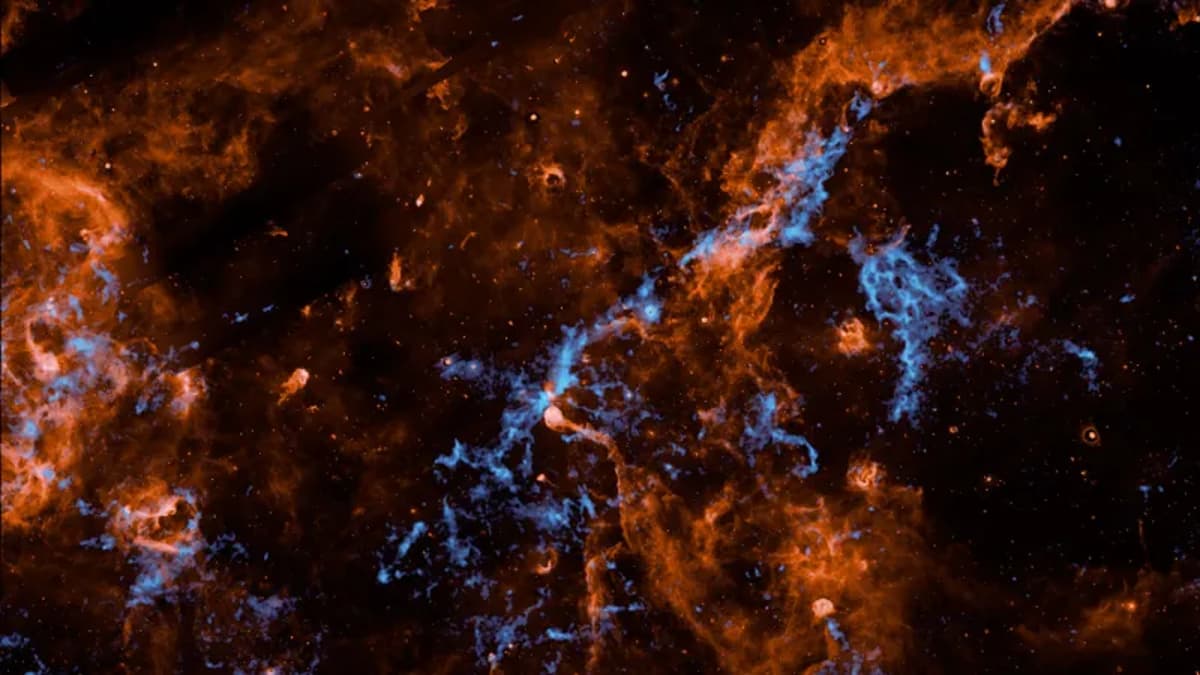
Clouds of Water Ice Thread Stellar Nurseries in the Milky Way
Why It Matters
Understanding the abundance and distribution of interstellar ice clarifies how planetary systems acquire water, a key ingredient for habitability, and guides future searches for water‑rich exoplanets.
Key Takeaways
- •SPHEREx mapped water ice across hundreds of light‑years in Cygnus X
- •Ice threads align with dust filaments in two major stellar nurseries
- •Findings suggest interstellar ice may seed oceans on forming planets
- •SPHEREx provides sky‑wide infrared maps, far broader than JWST
- •Researchers aim to quantify ice abundance to locate water‑rich worlds
Pulse Analysis
The discovery of galaxy‑spanning water‑ice clouds reshapes our view of the early stages of planet formation. While astronomers have long suspected that interstellar ice contributes to planetary oceans, direct, large‑scale observations were limited to narrow fields of view. By capturing the infrared signatures of ice over vast regions, SPHEREx confirms that water is not a localized curiosity but a pervasive component of the dust‑rich environments where stars and planets coalesce. This broader perspective strengthens the hypothesis that a significant fraction of a planet’s water budget originates from the interstellar medium rather than later delivery by comets or asteroids.
SPHEREx, launched in March 2025, is designed to survey the entire sky in near‑infrared wavelengths, completing four full‑sky passes during its two‑year mission. Its spectro‑photometric capability distinguishes ice by the characteristic absorption features that dim starlight at specific wavelengths, allowing scientists to map ice even when it is embedded within dense clouds. Compared with the James Webb Space Telescope’s high‑resolution but limited‑area studies, SPHEREx delivers a panoramic view, revealing how ice threads through the filamentary dust structures of Cygnus X and the North American Nebula. This comprehensive dataset provides a statistical baseline for assessing ice abundance across different galactic environments.
The implications extend beyond astrophysics into astrobiology and exoplanet exploration. If interstellar ice readily incorporates into protoplanetary disks, then nascent worlds forming in ice‑rich regions are more likely to inherit substantial water inventories, increasing their potential for habitability. Future analyses will quantify ice column densities, pinpointing zones where emerging planets may develop oceans from the outset. Such insights will inform target selection for upcoming missions seeking biosignatures, positioning SPHEREx as a cornerstone for the next generation of water‑focused exoplanet science.
Clouds of water ice thread stellar nurseries in the Milky Way
Comments
Want to join the conversation?
Loading comments...