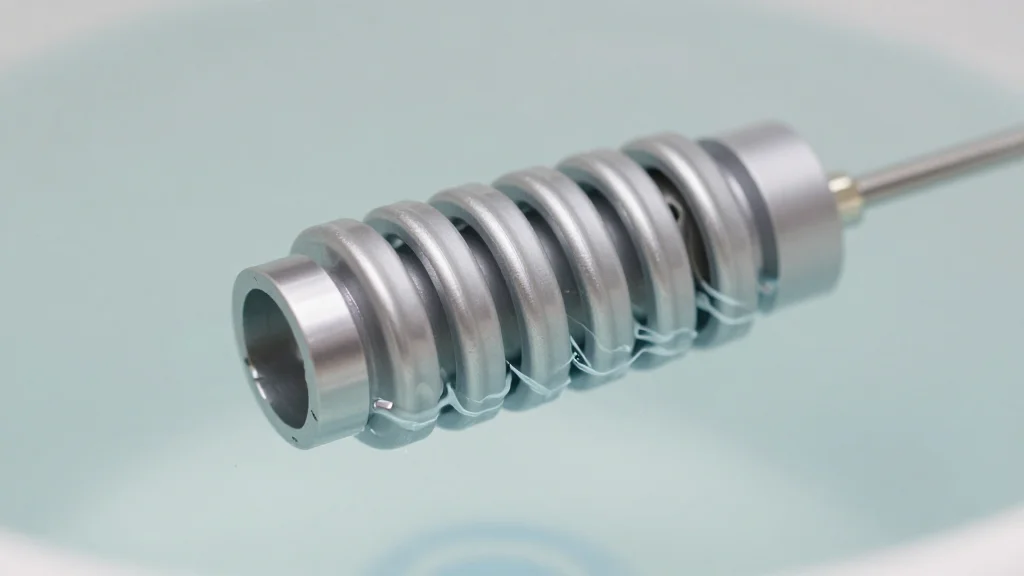
Coiled Phononic Structure Super-Resonates
Why It Matters
Broadband, passive flow‑control could reduce drag on aircraft wings without complex active systems, offering fuel savings and lower emissions. The technology may also translate to other industries where fluid‑induced turbulence is costly.
Key Takeaways
- •Coiled phononic subsurface reduces kinetic energy of four TS waves by ~1%
- •Device operates passively across broad frequency band, unlike single‑mode feedback
- •Structure combines aluminum, ABS plastic, and air cavities for tunable resonance
- •Super‑resonance achieved by coiling sheet so multiple segments contact flow
- •Numerical results suggest larger energy reductions with more instability modes
Pulse Analysis
Turbulence on aerodynamic surfaces remains a primary source of drag, directly impacting fuel consumption and operating costs for airlines and military aircraft. Conventional mitigation strategies rely on active control—sensors, actuators, and real‑time feedback—to target specific instability modes such as Tollmien‑Schlichting waves. While effective in laboratory settings, these systems are expensive, add weight, and typically address only a narrow frequency range, limiting their practical deployment across the diverse operating envelopes of modern aircraft.
The coiled phononic subsurface (PSub) introduced by Hussein and colleagues sidesteps these constraints by leveraging passive resonance. Constructed from lightweight aluminum, durable ABS polymer, and strategically placed air cavities, the PSub forms a thin sheet that sits flush with the solid‑fluid interface. By coiling the sheet, multiple resonant segments align with the flow, effectively expanding the device’s bandwidth—a phenomenon the authors label "super‑resonance." Computational fluid dynamics simulations demonstrate that, even with four concurrent Tollmien‑Schlichting waves spanning different frequencies, the coiled PSub attenuates the combined kinetic energy of the disturbances by nearly one percent, a modest figure that is expected to scale with additional modes.
If experimental validation confirms the simulated performance, the technology could reshape turbulence management across several sectors. In aviation, a lightweight, passive surface treatment could be retrofitted to existing wing designs, delivering incremental drag reductions without the penalty of active hardware. Beyond aerospace, the principle may apply to marine hulls, wind‑turbine blades, and industrial pipelines where flow‑induced vibrations degrade efficiency. Future work will likely focus on optimizing material configurations, scaling the concept for full‑scale components, and integrating the PSub with complementary passive devices to achieve cumulative drag‑saving benefits.
Coiled Phononic Structure Super-Resonates
Comments
Want to join the conversation?
Loading comments...