Why It Matters
The piece links a striking celestial object to the Sun’s eventual evolution, turning abstract astrophysics into a relatable experience for hobbyists and reinforcing demand for entry‑level telescopes. It underscores how public outreach can drive market growth for optical‑instrument manufacturers.
Key Takeaways
- •Ring Nebula (M57) lies ~2,200 light‑years away in Lyra
- •Visible with low‑power telescopes, ideal for amateur skywatchers
- •Represents Sun’s future planetary nebula phase in ~6 billion years
- •Planetary nebulae persist tens of thousands of years before dispersing
- •Celestron sponsors content, highlighting market demand for entry‑level scopes
Pulse Analysis
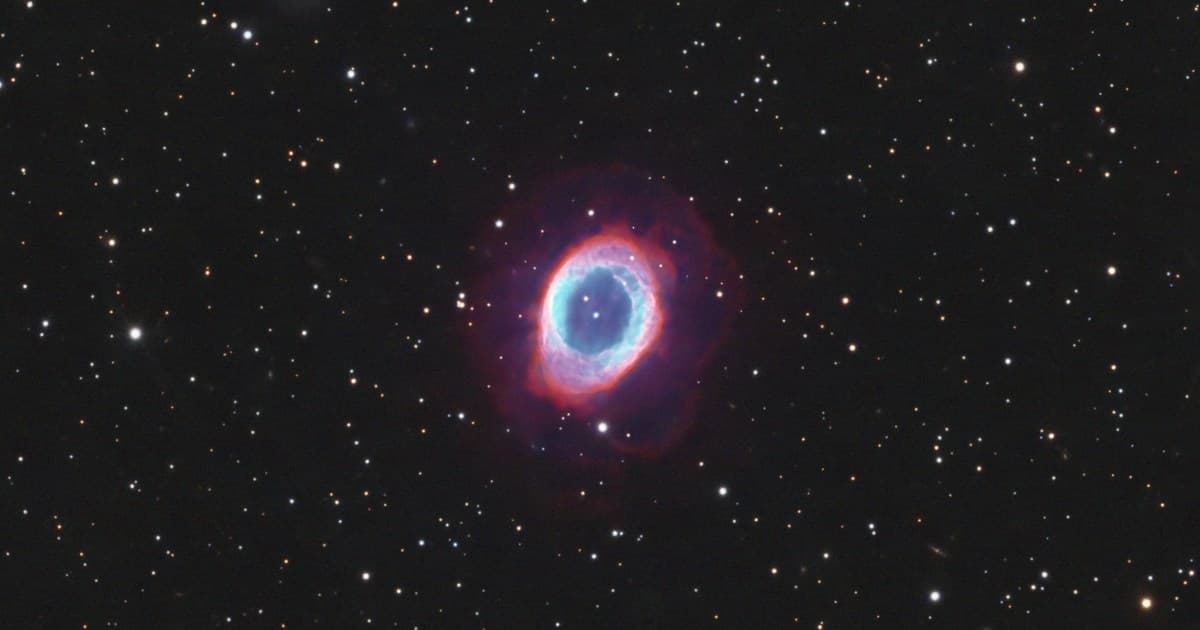
The Ring Nebula, cataloged as M57, is one of the most photographed planetary nebulae, located about 2,200 light‑years from Earth in the constellation Lyra. Formed when a Sun‑mass star exhausts its hydrogen fuel, the star ejects its outer envelope, leaving a dense white dwarf core that ionizes the expelled gas. The resulting glowing ring, visible in blue and red emission lines, persists for tens of thousands of years before merging with the interstellar medium. Its relatively high surface brightness makes it a prime target for small telescopes, offering a vivid illustration of stellar death cycles.
For the amateur astronomy market, the Ring Nebula serves as a low‑cost, high‑impact observing object that drives sales of entry‑level telescopes and accessories. Manufacturers such as Celestron leverage the nebula’s popularity in promotional content, positioning their optics as the gateway to “seeing the future of our Sun.” This synergy between scientific storytelling and product marketing fuels a steady demand for affordable refractors and Dobsonians, especially as urban light pollution pushes enthusiasts toward brighter, larger‑aperture instruments capable of capturing faint nebular details.
Beyond hobbyist appeal, planetary nebulae like M57 provide critical data for astrophysicists modeling stellar evolution and chemical enrichment of the galaxy. By studying the nebula’s composition and expansion rate, researchers refine predictions about the Sun’s ultimate transformation and its impact on the surrounding interstellar environment. Public outreach programs that tie these scientific insights to everyday observations help broaden STEM engagement, creating new audiences for both educational institutions and commercial telescope brands. As interest in space exploration grows, the Ring Nebula will remain a cornerstone example of how celestial phenomena can bridge scientific research, consumer markets, and public curiosity.
Come full circle with the Ring Nebula
Comments
Want to join the conversation?
Loading comments...