Confirming the Polarizing Effect of Chiral Molecules
Why It Matters
The result validates CISS as an intrinsic quantum property, opening pathways for molecular spintronic devices that could operate without ferromagnetic components. It also resolves a long‑standing debate, giving researchers a reliable platform for designing chiral‑based spin filters and quantum information elements.
Key Takeaways
- •Meyer’s team measured spin‑dependent currents on single heptahelicene domains.
- •Superconducting STM tip with Mn cluster revealed opposite spin polarizations.
- •Findings confirm CISS is intrinsic, not an experimental artifact.
- •Results suggest chiral molecules can actively polarize electrons, not just filter.
- •Single‑molecule junction approach eliminates interface‑change ambiguity.
Pulse Analysis
The chirality‑induced spin selectivity (CISS) effect has intrigued physicists for over two decades, promising a route to control electron spin using molecular handedness. Early studies relied on multilayer films sandwiched between ferromagnetic electrodes, leaving open the question of whether observed spin asymmetries stemmed from genuine molecular filtering or from magnetic‑field‑induced changes at the interfaces. By isolating individual heptahelicene domains and employing a superconducting scanning tunneling microscope tip, the new work sidesteps those ambiguities, delivering a clean measurement of spin‑dependent transport at the nanoscale.
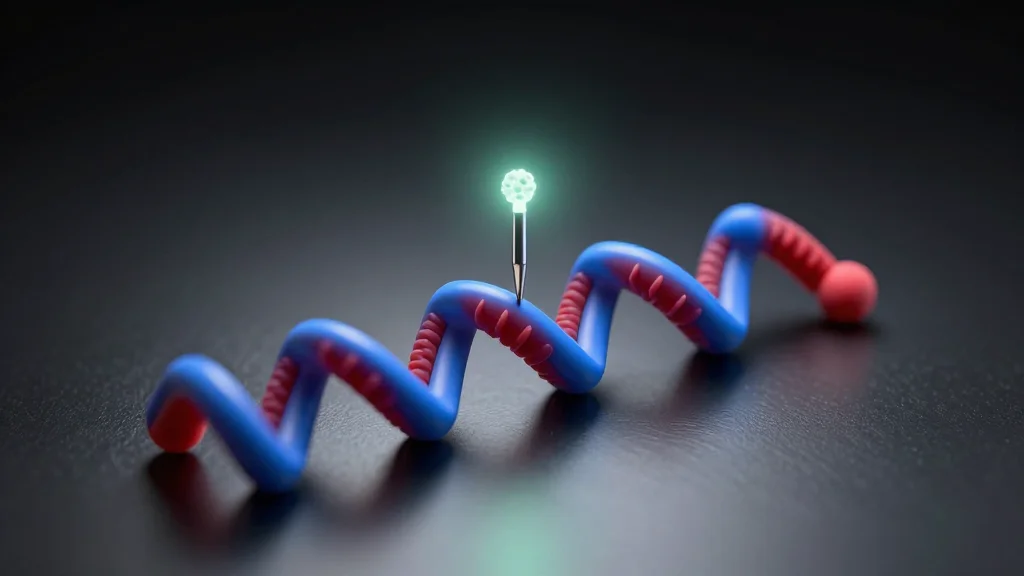
In the experiment, a manganese‑cluster‑decorated tip introduces a spin‑split energy level within the superconducting gap, producing two distinct voltage signatures for opposite spin polarizations. As the tip scans across alternating left‑ and right‑handed heptahelicene regions, the recorded current flips polarity in lockstep with the local chirality. This direct correlation between molecular handedness and spin orientation confirms that the molecules themselves act as spin polarizers, not merely passive filters. The methodology—single‑molecule junctions probed by superconducting STM—sets a new benchmark for future CISS investigations, offering reproducibility and eliminating confounding magnetic artifacts.
The implications extend beyond fundamental physics into practical spintronic applications. If chiral molecules can reliably generate spin‑polarized currents without ferromagnets, they could enable ultra‑compact, low‑power spin filters, magnetic‑field‑free memory elements, and components for quantum computing architectures. Industry players in molecular electronics and quantum device fabrication will likely explore integrating heptahelicene or similar chiral scaffolds into device stacks, leveraging their intrinsic spin‑polarizing capability to reduce material complexity and improve energy efficiency. Continued research will focus on elucidating the microscopic mechanism behind active spin polarization, a step that could accelerate the commercialization of chiral‑based spintronic technologies.
Confirming the Polarizing Effect of Chiral Molecules
Comments
Want to join the conversation?
Loading comments...