Why It Matters
The discovery confirms abundant, accessible ice in Mars’ mid‑latitudes, a critical resource for sustaining human outposts and advancing our understanding of the planet’s climate history.
Key Takeaways
- •MRO captured high‑resolution image of a 5.8‑mile crater on Mars.
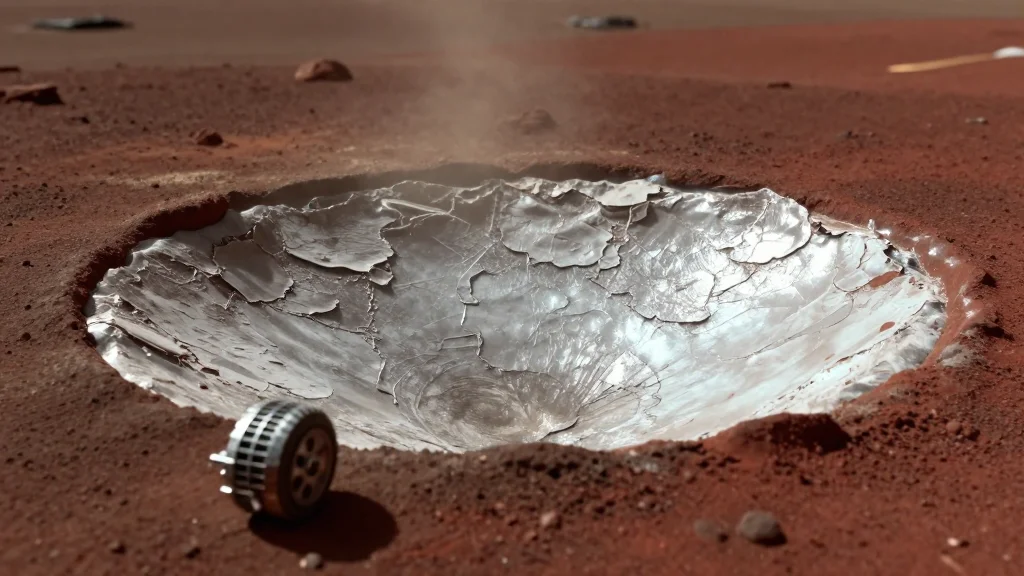
- •Crater floor shows peeling‑paint texture, indicating surface ice sublimation.
- •Soft rim and interior suggest ice‑rich topsoil throughout region.
- •Area lies within 2,000‑mile “glacier country” of northern mid‑latitudes.
- •Ice deposits could support future human habitats and in‑situ resource utilization.
Pulse Analysis
Mars’ “glacier country” has long intrigued planetary scientists because it hints at a hidden reservoir of water ice that could fuel future exploration. The latest HiRISE snapshot, taken on March 31, 2026, offers unprecedented detail of a 5.8‑mile crater whose interior appears mottled like peeling paint. This visual cue signals that surface ice is actively sublimating under the thin Martian atmosphere, exposing a thin, dust‑laden veneer while the bulk of the ice remains beneath. Such observations refine climate models that track the planet’s transition from a wetter past to its current arid state.
Geologically, the crater’s softened rim and the texture of its floor suggest prolonged interaction between ice and regolith. Sublimation erodes the surface, creating the observed “peeling” effect, while repeated freeze‑thaw cycles over millennia may have softened the crater walls. These processes provide a window into Mars’ recent climatic fluctuations, indicating that ice deposits persist at relatively shallow depths even in mid‑latitude zones previously thought to be too warm for stable ice. Understanding these dynamics helps scientists gauge the planet’s water budget and assess the longevity of surface ice under current conditions.
From an operational perspective, the presence of near‑surface ice in this region is a game‑changer for in‑situ resource utilization (ISRU). Future crews could harvest water for life support, fuel production, and radiation shielding, reducing the need for costly Earth‑launch supplies. The crater’s location within a 2,000‑mile stretch of ice‑rich terrain makes it an attractive staging ground for habitats, power generation, and scientific outposts. As agencies and private firms chart the next wave of Mars missions, sites like this crater will likely rank high on the priority list for sustainable colonization strategies.
Corroding glacial features inside Martian crater
Comments
Want to join the conversation?
Loading comments...