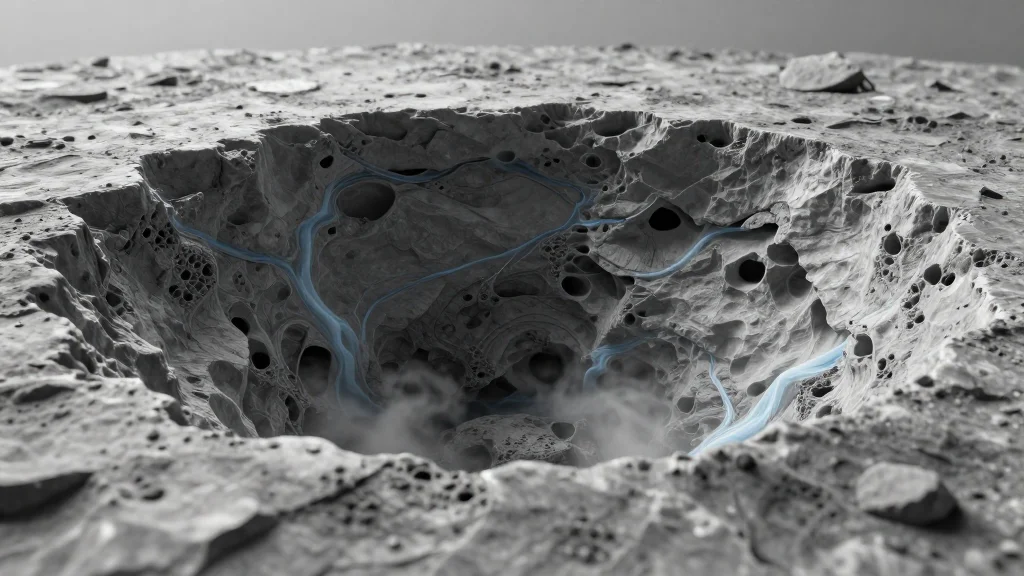
Cosmic Bombardment May Have Opened Earth's Crust for Prebiotic Chemistry
Why It Matters
By linking impact‑driven crustal permeability to hydrothermal systems, the study reshapes theories of how life‑supporting environments emerged on the early planet, guiding future astrobiology and geochemical models.
Key Takeaways
- •Impacts before 4.3 billion years increased crust permeability up to 8 km depth
- •Simulations used iSALE to model basalt crust under varying geothermal gradients
- •Porous zones could host hydrothermal systems conducive to prebiotic chemistry
- •Ocean presence modestly altered impact‑driven fracture networks
- •Study provides first quantitative framework linking bombardment to early habitability
Pulse Analysis
The Hadean and Archean eons were marked by relentless asteroid and planetesimal bombardment, a period that left few direct rock records but shaped the planet’s early environment. While the Moon’s cratered surface offers clues about impact frequency, scientists have long debated how those collisions altered Earth’s crust. Recent advances in shock‑physics modeling now allow researchers to reconstruct the mechanical effects of impacts on a basalt‑dominated early crust, revealing that each strike acted like a natural drill, fracturing rock and increasing porosity.
In the study led by Alexander et al., the team ran hundreds of iSALE simulations varying crust thickness, geothermal gradients, and ocean depth. The models showed that impacts before roughly 4.3 billion years ago could generate interconnected pore networks extending through the top 8 kilometers of the crust. Higher impact energies produced larger fracture zones, while hotter geothermal gradients amplified rock fragmentation. Even a shallow 5‑kilometer ocean modestly influenced the pattern of permeability, suggesting that early oceans and impact‑driven fractures co‑evolved to create dynamic hydrothermal systems.
These findings have profound implications for the origin of life. Hydrothermal circulation driven by impact‑induced permeability would have supplied heat, minerals, and chemical gradients essential for prebiotic synthesis. By quantifying the spatial extent of such habitats, the research provides a concrete framework for evaluating where and when life‑building chemistry could have occurred on early Earth. The approach also offers a template for assessing habitability on exoplanets that experience heavy bombardment, bridging planetary science and astrobiology in the quest to understand life’s universal origins.
Cosmic bombardment may have opened Earth's crust for prebiotic chemistry
Comments
Want to join the conversation?
Loading comments...