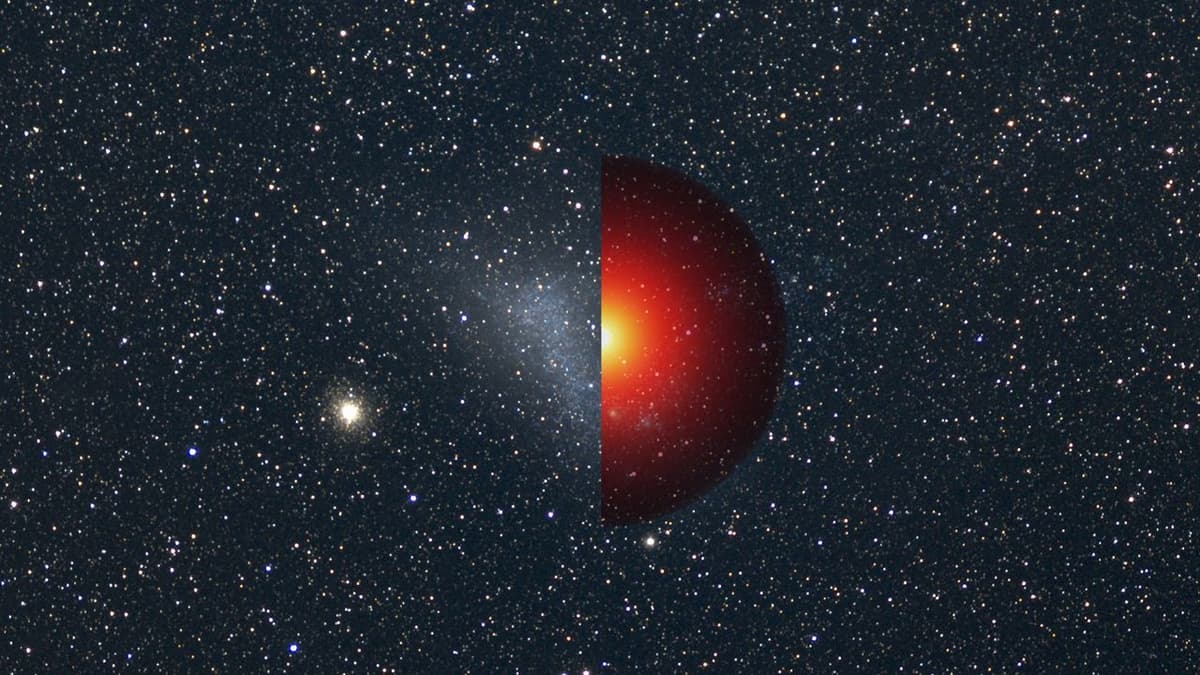
Could a Cosmic Uncertainty Principle Help Explain Dark Matter?
Why It Matters
If observations confirm the predicted equation‑of‑state deviation, the proposal could reshape our understanding of cosmic acceleration, eliminating the need for a mysterious cosmological constant. It also offers a unified quantum‑gravity‑inspired framework for both early‑ and late‑universe dynamics.
Key Takeaways
- •Proposes quantum uncertainty between scale factor and expansion rate.
- •Modified Friedmann equation yields acceleration without dark energy.
- •Predicts equation‑of‑state slightly > –1, testable by DESI, Euclid.
- •Positive exponent drives late‑time acceleration; negative exponent creates bounce.
- •Relies on flat‑universe assumption and single free exponent.
Pulse Analysis
The new cosmic‑uncertainty framework builds on a long‑standing tension in cosmology: the inexplicable value of the cosmological constant and the Hubble‑tension discrepancy. By promoting the scale factor and Hubble parameter to quantum operators, Koushiappas derives a modified Friedmann equation that mimics dark energy’s repulsive effect. This approach sidesteps the need for exotic fields or particles, positioning quantum fuzziness as the engine behind the universe’s accelerating expansion. The proposal aligns with recent hints from large‑scale structure surveys that the dark‑energy equation of state may deviate marginally from the canonical –1 value.
A distinctive feature of the model is its dual‑regime behavior. When the free exponent is positive, the deformation produces a late‑time acceleration that matches current supernova and cosmic‑microwave‑background observations. Conversely, a negative exponent replaces the singular Big Bang with a smooth bounce, offering a potential resolution to the initial‑condition problem that plagues standard cosmology. Both regimes emerge from the same underlying quantum‑mechanical principle, suggesting a unified description of early‑ and late‑universe physics. However, the theory hinges on a spatially flat universe and treats the expansion rate as a well‑behaved operator—assumptions that must survive rigorous scrutiny.
The coming decade will be decisive. The Dark Energy Spectroscopic Instrument, the Euclid mission, and the Vera C. Rubin Observatory are poised to measure the dark‑energy equation of state with unprecedented precision. Detecting a systematic shift above –1 would lend empirical weight to Koushiappas’s hypothesis, potentially prompting a paradigm shift away from Lambda‑CDM. Conversely, a null result would reinforce the need for alternative explanations. Either outcome will sharpen the dialogue between quantum theory and cosmology, underscoring the importance of innovative theoretical proposals in guiding observational strategy.
Could a cosmic uncertainty principle help explain dark matter?
Comments
Want to join the conversation?
Loading comments...