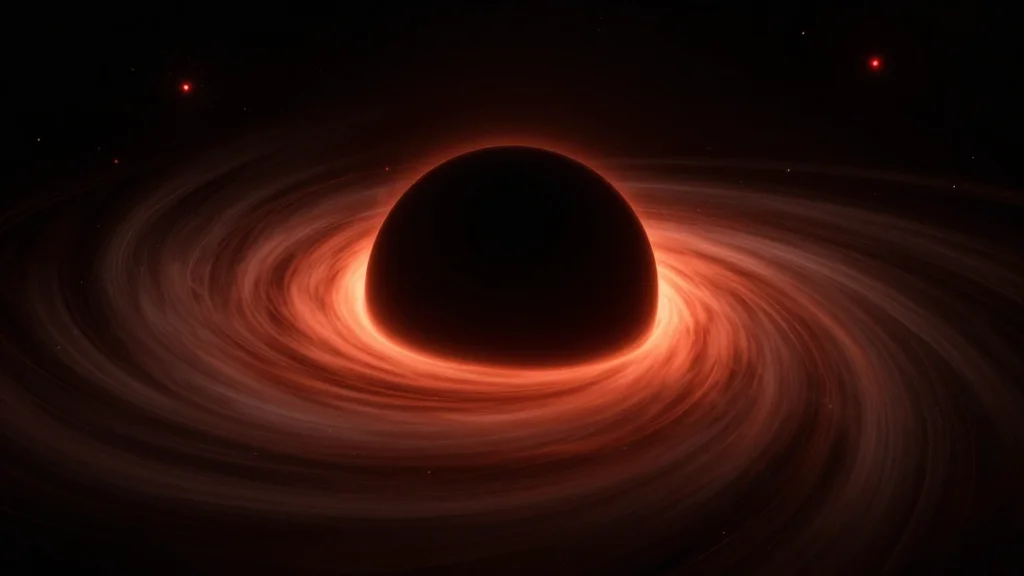
Could Dark Matter Be Made of Black Holes From a Different Universe?
Companies Mentioned
Why It Matters
If relic black holes make up dark matter, they provide a testable alternative to undiscovered particles and reshape our understanding of cosmic origins, influencing future observations in gravitational‑wave astronomy and galaxy formation.
Key Takeaways
- •Pre‑big‑bang bounce could leave relic black holes larger than 90 m.
- •Relic black holes may account for a dominant fraction of dark matter.
- •JWST’s “little red dots” could be descendants of ancient black holes.
- •Bounce model replaces singularity with quantum pressure from Pauli exclusion.
- •Gravitational‑wave background may carry signals from the previous contraction phase.
Pulse Analysis
Bouncing cosmology challenges the traditional big‑bang narrative by positing a pre‑expansion contraction that rebounds into our observable universe. In this scenario, quantum‑mechanical effects—specifically a pressure derived from the Pauli exclusion principle—prevent a true singularity, allowing structures larger than roughly 90 meters to survive the transition. The resulting “relics,” including primordial black holes, provide a natural bridge between early‑universe physics and the large‑scale structure we see today, while also offering a fresh perspective on inflation and dark energy.
The relic black holes emerging from the bounce are compelling dark‑matter candidates because they are massive, non‑luminous, and interact only through gravity. Their predicted abundance could account for a substantial, perhaps dominant, portion of the missing mass that shapes galaxies. Moreover, the James Webb Space Telescope’s discovery of unusually massive, red compact objects—dubbed “little red dots”—finds a ready explanation: these may be the luminous descendants of ancient black‑hole seeds that survived the bounce, accelerating the formation of supermassive black holes observed at high redshift.
Testing this framework hinges on next‑generation observations. A stochastic gravitational‑wave background, imprinted by the pre‑bounce epoch, could be detectable by forthcoming detectors such as LISA or the Einstein Telescope. Simultaneously, precise measurements of the cosmic microwave background and deep galaxy surveys will tighten constraints on the mass spectrum of primordial black holes. If evidence aligns, the bounce model would not only resolve the singularity problem but also unify dark matter, dark energy, and early‑universe inflation under a single quantum‑gravity narrative.
Could dark matter be made of black holes from a different universe?
Comments
Want to join the conversation?
Loading comments...