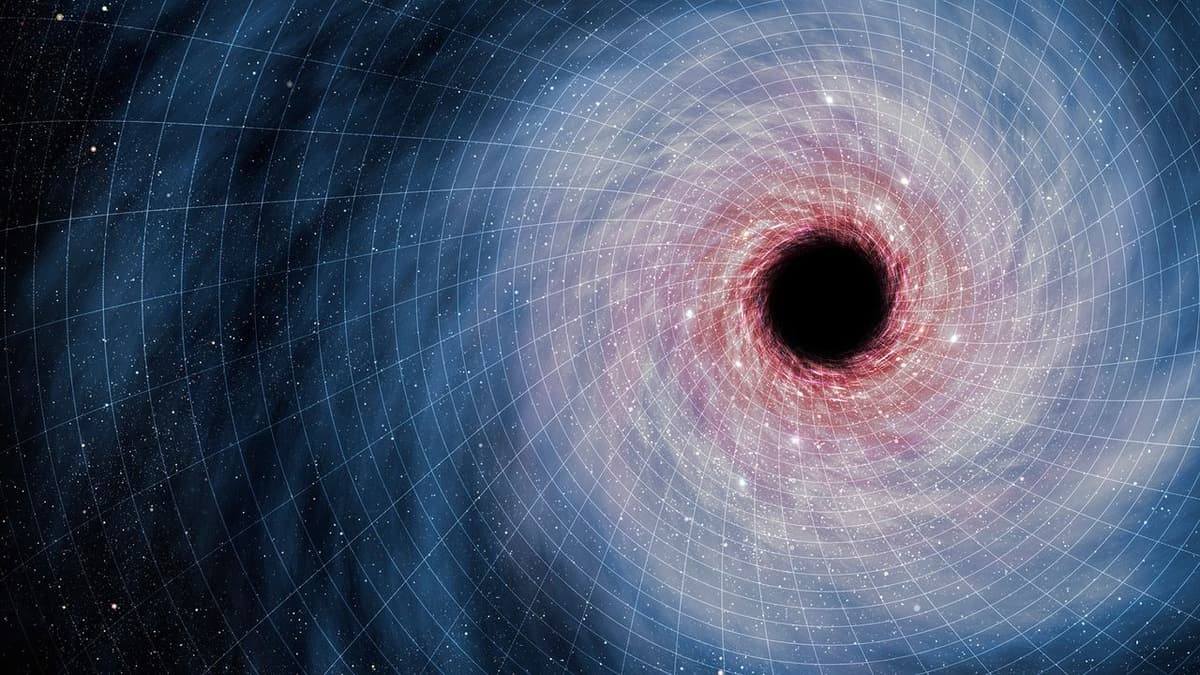
'Crystals' Of Space-Time Could Be the Origins of Certain Rare Black Holes, Theoretical Study Hints
Why It Matters
This work revives the long‑standing question of observable naked singularities, offering a concrete mathematical framework that could reshape our understanding of black‑hole formation and quantum gravity. Demonstrating feasibility across realistic dimensions would have profound implications for fundamental physics and astrophysical observations.
Key Takeaways
- •Space‑time crystals can mathematically produce naked singularities and microscopic black holes
- •Researchers solved Einstein‑Klein‑Gordon equations analytically using infinite‑dimensional limit
- •Gap: analytic works ≥52 dimensions; numerics only up to 14
- •Future work will extend numerics to higher dimensions to test realism
Pulse Analysis
The notion that spacetime might host crystal‑like structures dates back to the early 1990s, when Matthew Choptuik’s numerical experiments revealed a critical collapse that could produce a naked singularity—an object without an event horizon. Stephen Hawking’s famous wager with Kip Thorne and John Preskill highlighted the controversy: if such singularities existed, they would be visible, challenging the cosmic‑censorship conjecture that shields observers from infinite curvature. Over the decades, physicists have debated whether these exotic solutions are mere artifacts of idealized models or genuine possibilities within Einstein’s theory of general relativity.
The latest paper in Physical Review Letters tackles the problem with a pen‑and‑paper approach, exploiting a large‑dimension expansion of the Einstein‑Klein‑Gordon system. By sending the number of spacetime dimensions to infinity, the authors derived a concise analytic solution that describes a self‑similar spacetime crystal, a naked singularity, and the transition to a microscopic black hole. However, the solution only remains self‑consistent for dimensions of 52 or higher, whereas current high‑resolution simulations have been limited to 14 dimensions. This mismatch underscores a critical gap between analytic insight and computational capability.
Closing that gap could transform our grasp of quantum gravity and black‑hole physics. If future numerical work extends to the required dimensional regime, researchers could test whether the crystal‑induced singularities survive in a universe with four observable dimensions, potentially offering observable signatures such as high‑energy bursts or deviations in gravitational‑wave patterns. Even without direct detection, the framework enriches the toolbox for probing the limits of general relativity, informs string‑theory landscapes, and keeps the debate over cosmic censorship alive. The study therefore marks a pivotal step toward reconciling theory with the extreme environments explored by modern astrophysics.
'Crystals' of space-time could be the origins of certain rare black holes, theoretical study hints
Comments
Want to join the conversation?
Loading comments...