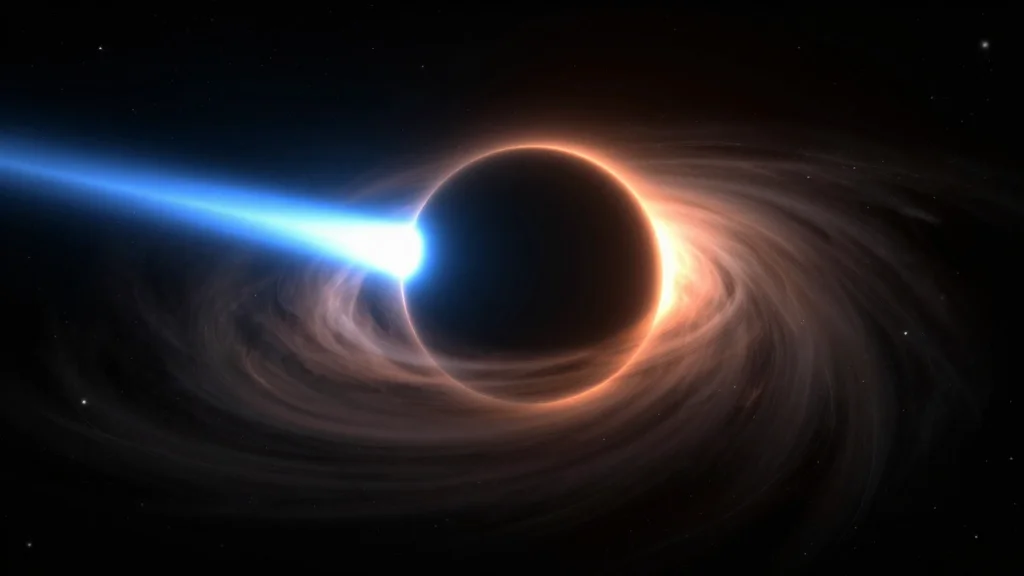
Curtin-Oxford Team Directly Measures Black‑Hole Jet Power at 10,000 Suns

Why It Matters
Directly measuring jet power transforms a theoretical parameter into an observable quantity, enabling tighter constraints on models of black‑hole feedback that drive galaxy formation theories. By anchoring simulations to real data, researchers can better predict how energy from black holes heats interstellar gas, suppresses star formation, and influences the large‑scale structure of the universe. Moreover, the methodology—using stellar‑wind bending to infer jet dynamics—opens a new observational window for studying relativistic jets across a range of astrophysical contexts. It demonstrates that even in complex binary environments, precise physical quantities can be extracted, paving the way for systematic surveys of jet energetics.
Key Takeaways
- •Curtin University and Oxford scientists measured Cygnus X‑1 jet power at ~10,000 Suns.
- •Jet speed determined to be ~0.5 c (150,000 km s⁻¹) using radio‑telescope array.
- •Method relies on jet deflection by the supergiant star's wind, providing a direct power estimate.
- •Result offers a concrete benchmark for black‑hole feedback models in galaxy evolution.
- •Technique can be applied to other black‑hole systems to build a broader jet‑power dataset.
Pulse Analysis
The ability to pin down jet power with a direct measurement marks a turning point for high‑energy astrophysics. Historically, jet energetics have been inferred from indirect signatures—radio flux, X‑ray luminosity, or theoretical scaling with black‑hole spin. Those proxies carry large systematic uncertainties, limiting the fidelity of cosmological simulations that depend on feedback prescriptions. By delivering a hard number, the Curtin‑Oxford study reduces a major source of model variance, allowing theorists to test whether current feedback implementations over‑ or under‑estimate the impact of jets on galactic gas reservoirs.
From a historical perspective, Cygnus X‑1 has served as a cornerstone for black‑hole physics since its discovery in the 1960s. Yet, despite decades of observation, the jet’s power remained elusive. This breakthrough demonstrates the maturity of very‑long‑baseline interferometry (VLBI) networks and the value of international collaboration. The global array’s resolution and sensitivity were essential to resolve the subtle bending of the jet, a feat that would have been impossible with a single facility.
Looking ahead, the measurement sets a precedent for leveraging binary dynamics to probe relativistic outflows. If similar analyses can be performed on supermassive black holes in active galactic nuclei, the field could finally bridge the gap between stellar‑mass and galactic‑scale jet physics. Such a bridge would clarify whether scaling laws derived from X‑ray binaries hold true for the most massive black holes, a question that underpins our understanding of how energy flows from the smallest to the largest structures in the cosmos. The next wave of observations, combined with next‑generation radio arrays like the Square Kilometre Array, promises to expand this frontier dramatically.
Curtin-Oxford Team Directly Measures Black‑Hole Jet Power at 10,000 Suns
Comments
Want to join the conversation?
Loading comments...