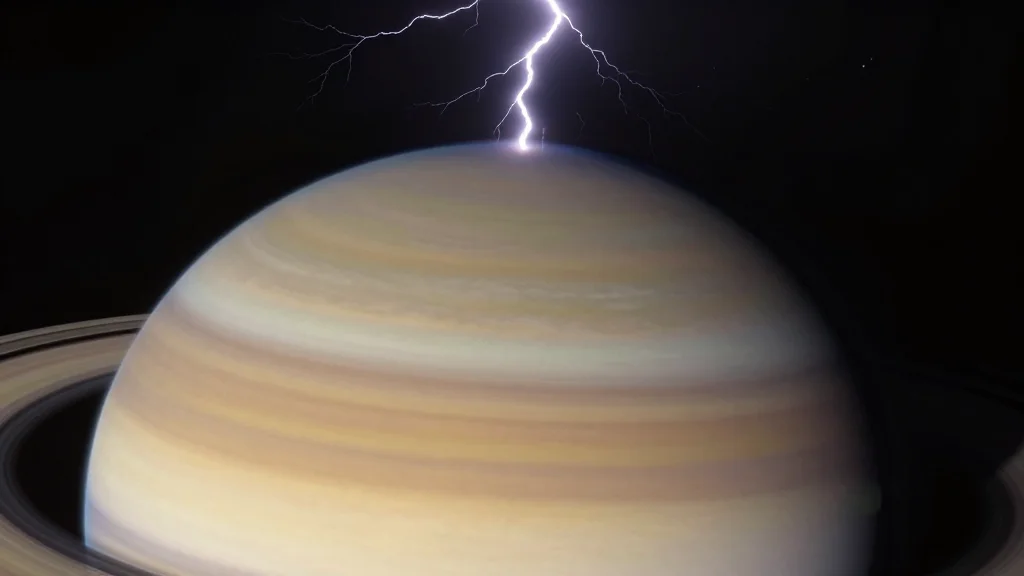
Czech Scientists Pinpoint Saturn Lightning to 35° North, Solving 45‑Year Mystery

Why It Matters
Accurately locating Saturn’s lightning sources resolves a long‑standing discrepancy that has hampered atmospheric models of the planet. By confirming that the most powerful discharges occur in mid‑latitude storm zones, scientists can better calibrate simulations of heat transport, cloud formation, and magnetic coupling in gas giants. The work also demonstrates a cost‑effective pathway for extracting fresh insights from legacy datasets, a strategy that could be pivotal as budgets tighten for new deep‑space missions. Beyond Saturn, the methodology sets a precedent for re‑examining archival data from Voyager, Galileo, and other early missions. If similar “over‑the‑horizon” effects are identified elsewhere, our broader picture of planetary weather—and the role of lightning in atmospheric chemistry—may need substantial revision.
Key Takeaways
- •Czech Academy of Sciences team led by Masafumi Imai identified Saturn lightning at 35° N latitude.
- •Re‑analysis combined Voyager 1980‑81 radio data with Cassini 2004‑2017 measurements.
- •The “over‑the‑horizon effect” in Saturn’s ionosphere caused earlier equatorial mis‑location.
- •Voyager’s radio receivers were not designed for short‑pulse lightning detection, leading to errors.
- •Findings published in JGR: Planets; methodology to be applied to Jupiter and Uranus.
Pulse Analysis
The resolution of Saturn’s lightning mystery illustrates how legacy data can be revitalized with modern analytical frameworks. Historically, the Voyager probes were celebrated for their pioneering measurements, yet their instrumentation was limited by the technology of the 1970s. By overlaying Cassini’s sophisticated polarization data, the Czech team effectively retrofitted a 40‑year‑old dataset, turning a historical blind spot into a new source of insight. This approach could become a standard practice as the planetary science community grapples with the high cost and long lead times of new deep‑space missions.
From a scientific standpoint, the corrected lightning location aligns with visual observations of Saturn’s mid‑latitude storm belts, reinforcing the link between deep convection and electrical activity. This convergence of radio and optical data strengthens confidence in global circulation models that have struggled to reconcile disparate measurements. Moreover, the discovery may influence how we interpret exoplanetary atmospheres; lightning signatures are a potential biosignature, and understanding their generation mechanisms on our own gas giants provides a crucial reference point.
Looking ahead, the team’s plan to apply the same technique to Jupiter and Uranus could uncover systematic biases in our current planetary weather paradigms. If similar ionospheric refraction effects are found, it may prompt a reevaluation of past conclusions about storm energetics and magnetic coupling across the outer solar system. In a broader sense, the study underscores a shift toward data‑centric planetary science, where the archival treasure trove of past missions is mined with ever‑more sophisticated tools, delivering high‑impact discoveries without the need for immediate new spacecraft.
Czech Scientists Pinpoint Saturn Lightning to 35° North, Solving 45‑Year Mystery
Comments
Want to join the conversation?
Loading comments...