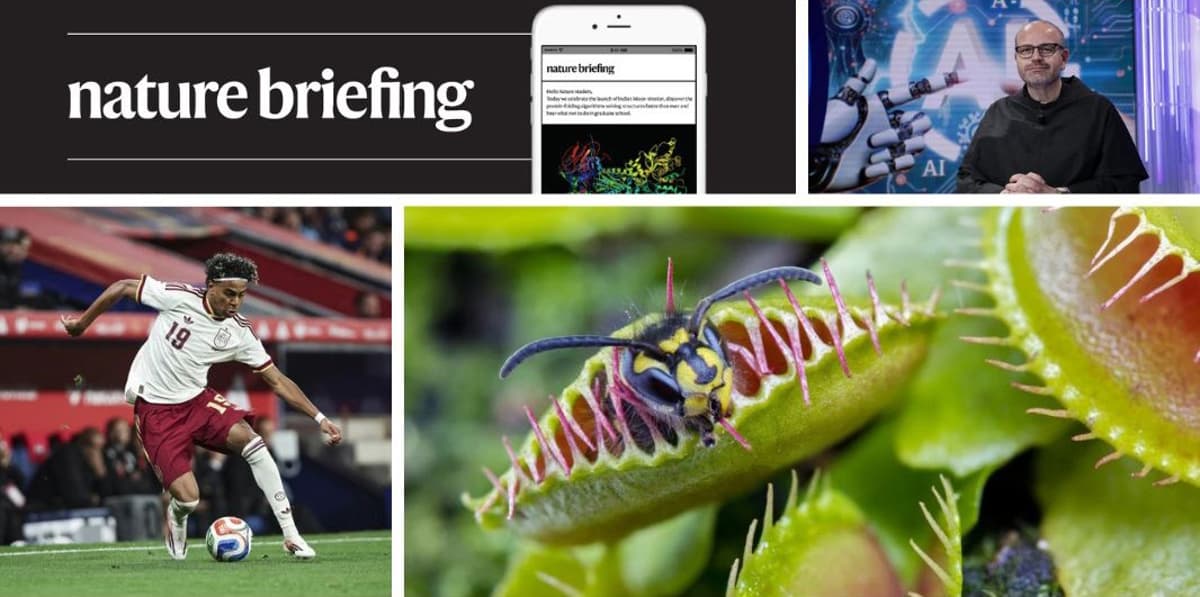
Daily Briefing: How Venus Flytraps Snap Shut
Why It Matters
The findings reshape our understanding of rapid plant movement, while AI integration in elite sports and high‑level calls for AI governance signal transformative shifts across biology, entertainment, and policy. Public‑health tracing of the hantavirus outbreak underscores the need for swift, data‑driven responses to emerging threats.
Key Takeaways
- •Flytraps soften outer cells to snap shut faster than any known plant
- •World Cup teams will use AI for player tracking and referee aid
- •Pope Leo XIV’s AI warning urges scientists to engage in regulation
- •Hantavirus outbreak on MV Hondius traced to infections 2,000 km north
- •Study suggests enzymes may weaken cell walls during Venus flytrap capture
Pulse Analysis
The revelation that Venus flytraps achieve their lightning‑fast closure by softening outer cell walls challenges long‑standing assumptions about plant biomechanics. Researchers suspect a rapid release of enzymes weakens the cell wall matrix, allowing the hinged lobes to fold in milliseconds. This mechanism not only deepens our grasp of carnivorous plant evolution but also offers a blueprint for biomimetic materials that require swift, reversible shape changes, a frontier of interest for soft‑robotics engineers.
Meanwhile, the 2026 World Cup is set to become a showcase for artificial‑intelligence applications in sport. Teams will deploy AI platforms that ingest real‑time positional data, generating predictive models of player fatigue and tactical adjustments. Referees, equipped with digital avatars, will receive instant visualizations of potential fouls, promising greater accuracy and transparency. This convergence of data science and athletics reflects a broader trend where high‑stakes entertainment increasingly relies on sophisticated analytics to enhance performance and viewer engagement.
Beyond the stadium, AI’s societal impact is underscored by Pope Leo XIV’s recent admonition, which calls on scientists to embed ethical oversight into AI development. The papal message aligns with growing calls for third‑party audits and robust governance frameworks, especially as AI permeates sectors like criminal justice and healthcare. Concurrently, the hantavirus outbreak aboard MV Hondius illustrates how rapid genomic tracing can pinpoint infection sources across vast distances, reinforcing the importance of interdisciplinary collaboration in managing emerging public‑health crises. Together, these stories highlight a world where biology, technology, and policy intersect more tightly than ever.
Daily briefing: How Venus flytraps snap shut
Comments
Want to join the conversation?
Loading comments...