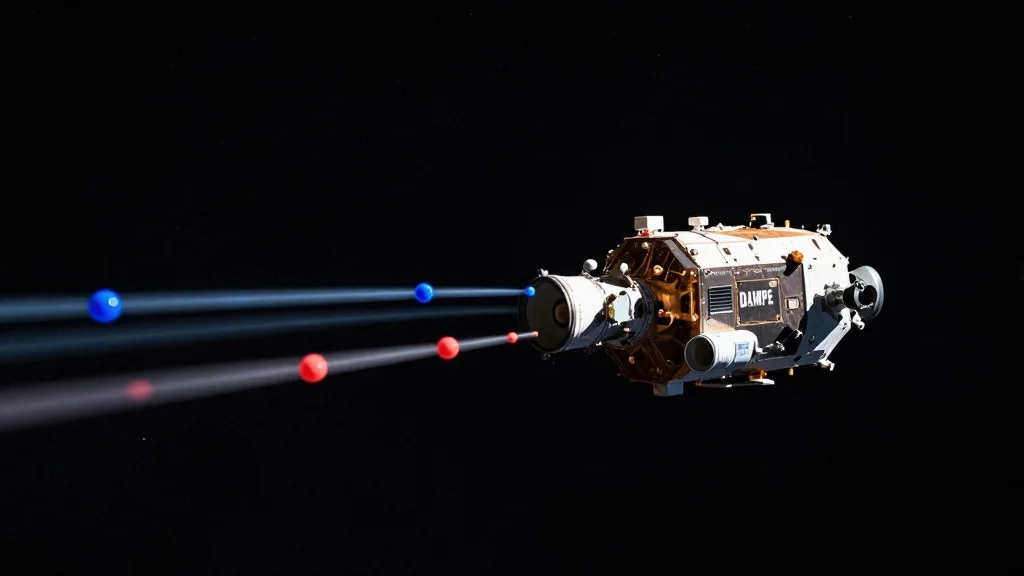
DAMPE Observes Charge-Dependent Limit of Cosmic Ray Acceleration
Why It Matters
Understanding the charge‑dependent limit reshapes theories of how cosmic rays attain ultra‑high energies, influencing both fundamental astrophysics and the design of next‑generation space observatories.
Key Takeaways
- •DAMPE measured cosmic rays up to 100 TeV per nucleon.
- •Acceleration cutoff scales with particle charge, limiting heavier nuclei.
- •Findings challenge standard shock‑acceleration models.
- •Results aid design of next‑generation gamma‑ray observatories.
Pulse Analysis
Cosmic rays—high‑energy particles that constantly bombard Earth—have long puzzled scientists seeking to pinpoint their origins and acceleration mechanisms. Traditional models, especially diffusive shock acceleration in supernova remnants, assume that particles can be accelerated to a universal energy ceiling, independent of their charge. The DArk Matter Particle Explorer (DAMPE), launched by China in 2015, was built to probe the high‑energy universe, offering unprecedented resolution for electrons, gamma rays, and nuclei up to hundreds of tera‑electronvolts.
In its latest analysis, DAMPE revealed that the maximum energy attainable by cosmic‑ray nuclei is not uniform but scales with electric charge. Protons were observed near 100 TeV per nucleon, while helium and heavier elements such as carbon and iron displayed progressively lower cutoffs. This charge‑dependent behavior suggests that magnetic rigidity, rather than sheer kinetic energy, governs the acceleration ceiling, contradicting the long‑standing assumption of a charge‑agnostic limit. The data set, collected over several years, benefits from DAMPE’s deep calorimeter and precise charge identification, providing the statistical power needed to discern these subtle trends.
The implications ripple through both theoretical and practical realms. Astrophysicists must now refine acceleration models to incorporate rigidity‑limited processes, potentially revisiting the role of magnetic turbulence and shock geometry in supernova remnants. For the space‑instrumentation industry, the results underscore the value of high‑resolution, charge‑sensitive detectors, guiding the development of upcoming missions like the Chinese HERD and the U.S. AMEGO‑X. Ultimately, a clearer picture of cosmic‑ray acceleration informs broader questions about galaxy‑scale particle transport, high‑energy neutrino production, and the interstellar medium’s energetic budget.
DAMPE Observes Charge-dependent Limit of Cosmic Ray Acceleration
Comments
Want to join the conversation?
Loading comments...