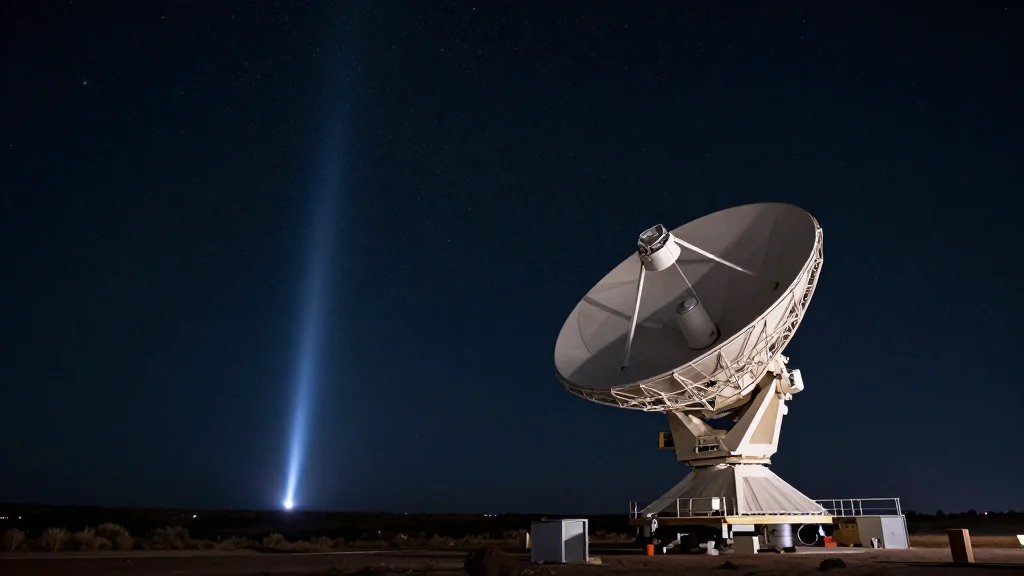
'Dancing Jets' From Black Hole Reveal an Immense Power Equivalent to 10,000 Suns
Why It Matters
Confirming the jet power fraction anchors models of how black holes regulate galaxy growth, improving predictions of large‑scale structure formation. The measurement also demonstrates a new observational technique for probing black‑hole energetics in real time.
Key Takeaways
- •Jets from Cygnus X-1 emit power equal to 10,000 suns.
- •Measured jet power equals about 10% of accretion energy release.
- •Jet speed determined at half light speed, ~150,000 km/s.
- •Earth‑spanning radio array captured jet bending by stellar wind.
- •Result anchors simulations of black‑hole feedback across galaxy scales.
Pulse Analysis
Black‑hole jets are among the most energetic phenomena in the cosmos, channeling a fraction of the gravitational energy released as matter spirals inward. In the Cygnus X‑1 system, a stellar‑mass black hole orbits a massive supergiant, and its powerful radio jets are periodically deflected by the star’s fierce wind. By synchronizing observations from a global network of radio dishes, researchers captured a sequence of “dancing jets,” allowing them to calculate the jets’ instantaneous power for the first time. This direct measurement bridges a long‑standing gap between theory and observation, confirming that roughly one‑tenth of the infalling matter’s energy is expelled via jets.
The quantified jet power—equivalent to the combined luminosity of 10,000 suns—has immediate implications for astrophysical modeling. Simulations of galaxy formation routinely assume a 10 % feedback efficiency, but empirical validation was lacking. With this anchor point, cosmologists can refine how jet‑driven outflows heat interstellar gas, suppress star formation, and shape the morphology of galaxies over billions of years. Moreover, the observed jet velocity of about 150,000 km s⁻¹ (half light speed) provides a benchmark for relativistic jet physics, informing models of particle acceleration and magnetic field dynamics near event horizons.
Looking ahead, the methodology demonstrated here will scale with next‑generation facilities such as the Square Kilometre Array (SKA). The SKA’s unprecedented sensitivity will enable similar jet‑power measurements across millions of distant galaxies, turning a single case study into a statistical tool for probing black‑hole feedback throughout cosmic history. As observational capabilities expand, the synergy between precise radio imaging and theoretical frameworks promises deeper insight into how black holes, despite their small size, wield outsized influence on the evolution of the universe.
'Dancing jets' from black hole reveal an immense power equivalent to 10,000 suns
Comments
Want to join the conversation?
Loading comments...