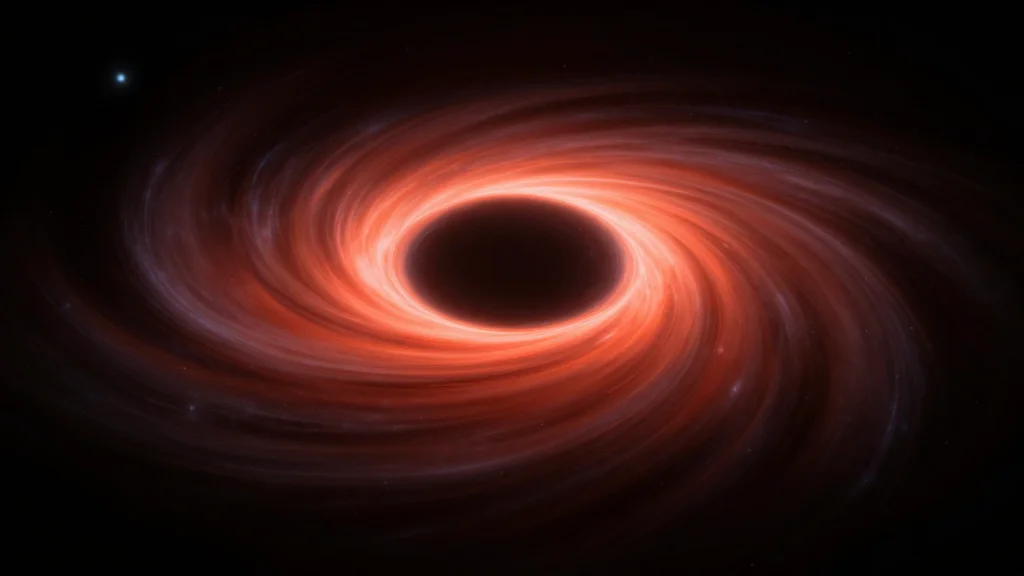
Dark Matter Could Explain the Earliest Supermassive Black Holes
Why It Matters
If dark‑matter decay drives early black‑hole formation, it bridges a major gap between cosmological theory and JWST observations, reshaping our understanding of galaxy evolution and particle physics.
Key Takeaways
- •Decaying dark matter may accelerate early galaxy collapse into black holes.
- •Mass range 24‑27 eV identified as optimal for black‑hole seeding.
- •James Webb observations of massive early black holes support the theory.
- •Energy from each dark‑matter decay equals ~10⁻⁹ of an AA battery.
- •Study links particle physics to cosmology, opening new dark‑matter detection avenues.
Pulse Analysis
The discovery of billion‑solar‑mass black holes within the first few hundred million years after the Big Bang has strained conventional growth models, which rely on steady accretion or mergers over long timescales. The James Webb Space Telescope has now catalogued several such behemoths, prompting scientists to revisit the physics of the early universe. Traditional direct‑collapse scenarios require rare, finely tuned radiation fields to suppress star formation, making them statistically unlikely. This tension has motivated researchers to explore exotic mechanisms that could tip the balance toward rapid black‑hole seeding.
Aggarwal and colleagues introduce a novel twist: the slow decay of dark‑matter particles. By injecting an infinitesimal amount of energy—roughly a billion trillionths of an AA battery’s output—into pristine hydrogen gas, the decay alters the gas’s thermochemical pathways, preventing cooling that would otherwise lead to star formation. Their simulations pinpoint a narrow dark‑matter mass window between 24 and 27 electronvolts, where axion‑like particles decay at just the right rate to foster direct collapse. This energy injection is sufficient to keep the gas hot and dense, allowing it to bypass the stellar phase and implode directly into a massive black‑hole seed.
The implications extend beyond astrophysics. If early black holes are indeed fingerprints of decaying dark matter, they provide a cosmic laboratory for particle physics, offering indirect detection avenues complementary to terrestrial experiments. Future JWST surveys and next‑generation observatories like the Nancy Grace Roman Space Telescope could test the predicted abundance and distribution of such black holes. Confirming the link would not only solve a long‑standing cosmological puzzle but also illuminate the elusive nature of the universe’s dominant, yet invisible, mass component.
Dark matter could explain the earliest supermassive black holes
Comments
Want to join the conversation?
Loading comments...