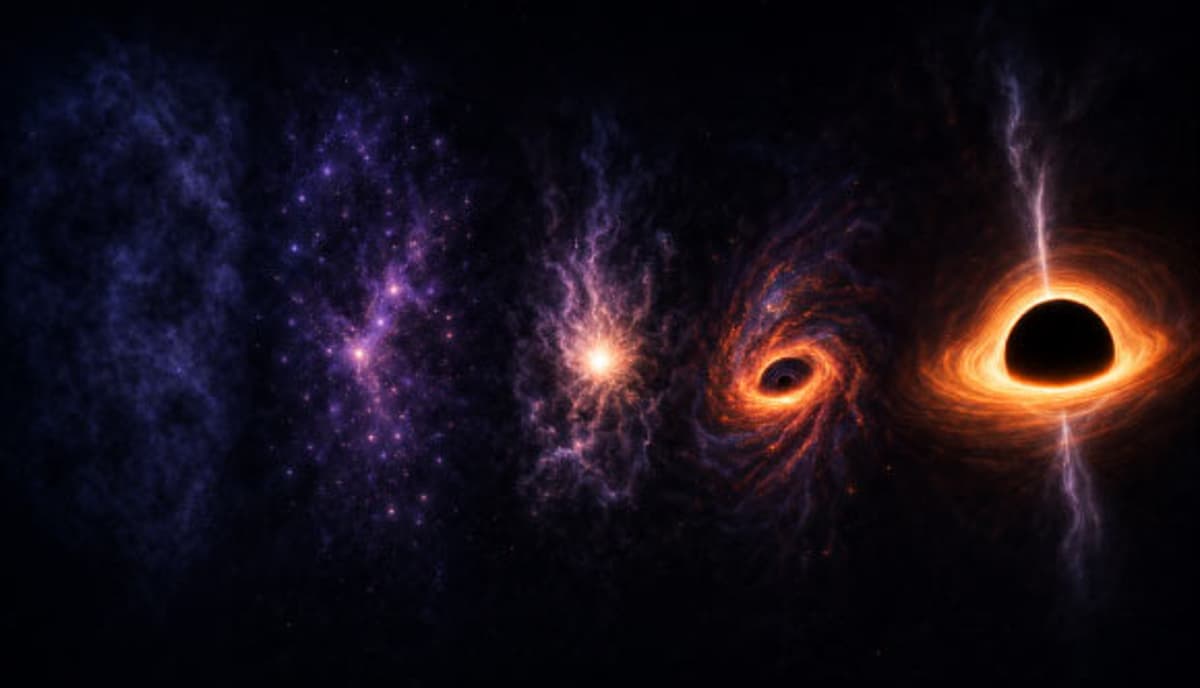
Dark Matter May Have Jump-Started Universe’s First Giant Black Holes
Why It Matters
If correct, the hypothesis bridges the gap between observed early‑epoch supermassive black holes and theoretical formation timelines, reshaping dark‑matter and galaxy‑formation models.
Key Takeaways
- •Decaying dark matter could trigger direct collapse of early gas clouds.
- •Energy injection needed is a billion‑trillionth of an AA battery.
- •Dark matter mass window 24‑27 eV enables black‑hole seeding.
- •Findings help explain supermassive black holes observed by JWST.
- •Interdisciplinary collaboration linked particle physics and cosmology.
Pulse Analysis
The discovery of quasars harboring billion‑solar‑mass black holes less than a billion years after the Bang has long strained conventional astrophysical models. Standard scenarios rely on the gradual accretion of matter onto stellar‑mass seeds, a process that struggles to reach observed masses within the limited cosmic time. The James Webb Space Telescope (JWST) has amplified the tension by revealing an expanding census of such early giants, prompting researchers to explore exotic pathways that could accelerate black‑hole growth.
The new paper by Aggarwal et al. introduces decaying dark matter as a catalyst for “direct collapse” black holes. In their simulations, axion‑like particles with masses between 24 and 27 eV slowly decay, depositing an energy amount equivalent to a billion‑trillionth of an AA battery into surrounding hydrogen gas. This minuscule heating perturbs the delicate balance of molecular hydrogen formation, suppressing cooling and allowing the gas cloud to collapse under its own gravity without fragmenting into stars. The result is a massive seed—potentially 10⁴–10⁵ solar masses—ready to grow rapidly.
If decaying dark matter can indeed seed early supermassive black holes, it opens a novel observational window on the particle’s properties. The predicted mass range aligns with certain axion models, suggesting that future cosmological surveys or indirect detection experiments could test the hypothesis. Moreover, the study exemplifies how cross‑disciplinary workshops—bringing together particle physicists, cosmologists and astrophysicists—can generate breakthroughs that reshape both dark‑matter theory and galaxy‑formation narratives. Upcoming JWST deep‑field programs and next‑generation X‑ray observatories will be crucial for confirming whether these primordial black holes bear the imprint of dark‑matter decay.
Dark Matter May Have Jump-Started Universe’s First Giant Black Holes
Comments
Want to join the conversation?
Loading comments...