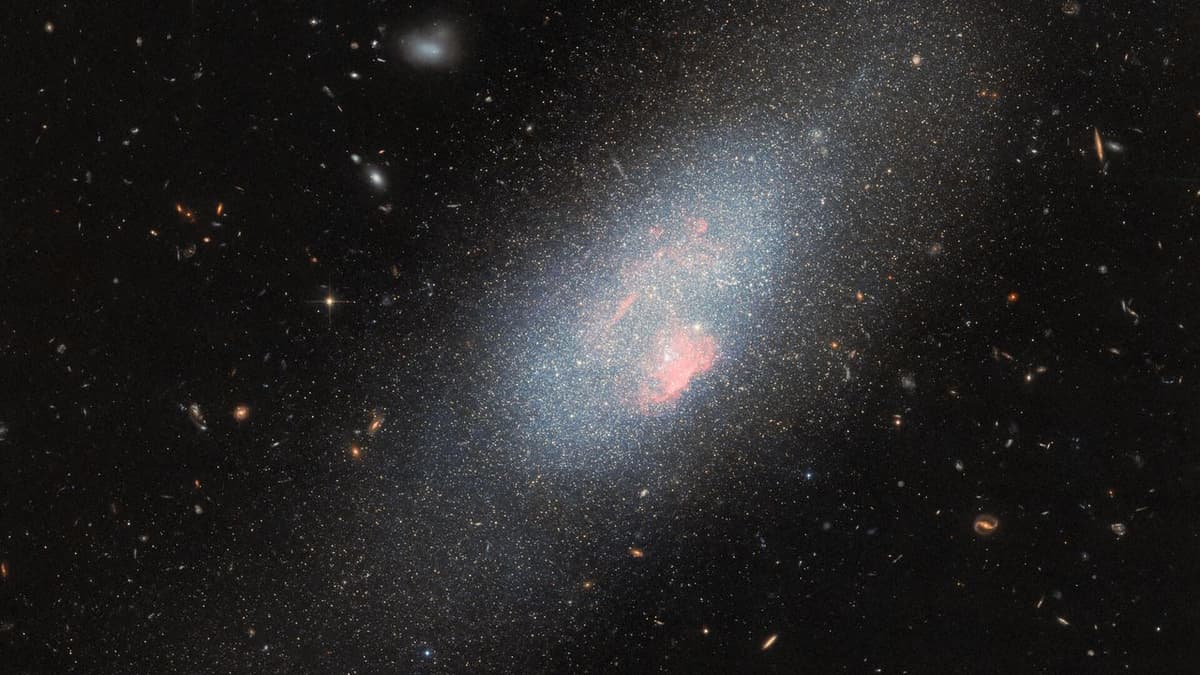
'Dark Subhaloes' May Explain Why Galaxies Seem to Form Pre-Determined Shapes
Why It Matters
The framework links dark‑matter substructure to observable dwarf galaxy morphologies, offering a testable bridge between cosmological simulations and real‑world data. It reshapes how researchers interpret dwarf galaxy diversity and constrains dark‑matter models.
Key Takeaways
- •Dark subhaloes cause stochastic heating, expanding dwarf galaxy stellar orbits
- •Simulations show dwarfs shed over 99% dark matter before losing stars
- •Milky Way satellites match predicted tidal tracks and velocity dispersion ratios
- •Isolated dwarfs may need ~14 billion years to reach the attractor
- •Dynamical attractor implies dwarf shapes converge despite varied beginnings
Pulse Analysis
The new "dynamical attractor" model reframes dwarf spheroidal galaxies not as static relics but as evolving systems driven by hidden dark‑matter clumps. These dark subhaloes generate random gravitational kicks that heat stellar populations, pushing stars onto wider orbits and gradually puffing up the galaxy. This internal heating operates continuously, independent of external influences, and explains why many dwarfs display a smooth, core‑like stellar distribution rather than the steep cusps predicted by simple dark‑matter halos.
Peñarrubia and Nadler validated their theory with high‑resolution N‑body experiments that tracked billions of particles over cosmic time. When placed on eccentric orbits around a simulated Milky Way, dwarf models lost more than 99% of their original dark matter before significant stellar stripping occurred. The remaining stars settled onto tidal tracks whose velocity dispersion settled at roughly half the peak dark‑matter speed—a ratio that aligns with measurements of real Milky Way satellites. Even isolated dwarfs, free from tidal harassment, follow the same trajectory, albeit over a timescale comparable to the universe’s age.
Beyond explaining dwarf morphology, the attractor concept offers a new diagnostic for dark‑matter physics. If subhalo‑induced heating is universal, deviations in observed dwarf kinematics could signal alternative dark‑matter properties or missing baryonic effects. However, challenges remain, such as the mass‑anisotropy degeneracy that hampers precise halo mass estimates. Upcoming surveys like the Vera C. Rubin Observatory will provide deeper stellar velocity data, enabling tighter tests of the attractor hypothesis and potentially narrowing the field of viable dark‑matter models. This synergy between simulation and observation marks a pivotal step toward unraveling the small‑scale mysteries of the cosmos.
'Dark subhaloes' may explain why galaxies seem to form pre-determined shapes
Comments
Want to join the conversation?
Loading comments...