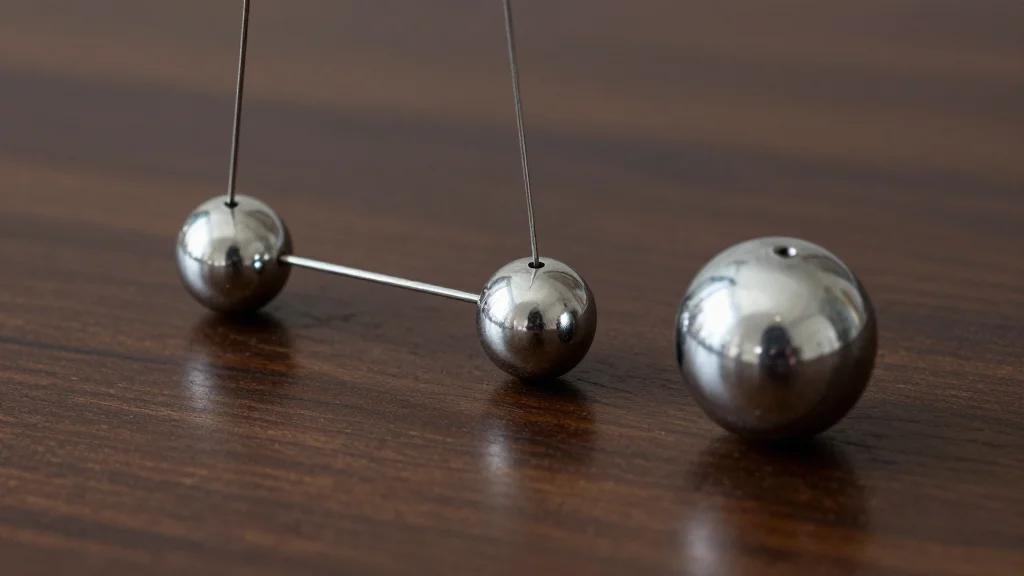
Decade-Long NIST Experiment Finds New Discrepancy in Gravitational Constant

Why It Matters
A precise value for the gravitational constant is essential for high‑accuracy navigation, geodesy, and fundamental tests of physics. Discrepancies in G propagate into uncertainties in planetary ephemerides, satellite drag models, and the calibration of experiments that probe the limits of Einstein’s theory. The ongoing lack of agreement also signals that our measurement techniques may still be missing subtle influences, prompting a re‑examination of experimental design across the field. Beyond practical applications, the mystery surrounding Big G fuels theoretical speculation. Some physicists argue that the spread of values could hint at new physics, such as variations in gravity at different scales or undiscovered forces. While most researchers attribute the spread to experimental error, the debate keeps the constant at the forefront of both metrology and fundamental physics discussions.
Key Takeaways
- •NIST released a new measurement of Newton’s constant after a ten‑year experiment.
- •The result conflicts with CODATA’s recommended value and prior experiments.
- •Big G’s current uncertainty stands at 22 ppm, far larger than other constants.
- •Researchers cite systematic errors and plan redesigns and international cross‑checks.
- •Accurate G is critical for satellite navigation, geodesy, and tests of relativity.
Pulse Analysis
The latest NIST outcome underscores a broader pattern: as measurement technology advances, the margin for hidden systematic error shrinks, yet the spread in reported values for G remains stubbornly wide. This paradox suggests that the community may need to adopt a multi‑method approach, where torsion balances, atom interferometers, and cryogenic pendulums are all deployed in parallel to triangulate the true constant. Historically, breakthroughs in metrology have often come from such cross‑disciplinary validation, as seen with the redefinition of the kilogram in 2019.
From a strategic perspective, the persistent ambiguity around G could influence funding priorities. Agencies may allocate more resources to develop next‑generation apparatuses that can isolate gravitational interactions from environmental noise at unprecedented levels. Moreover, the debate fuels interest in alternative theories of gravity, prompting theoretical physicists to revisit models that predict slight variations in G under specific conditions. While the new NIST figure does not overturn any established theory, it keeps the conversation alive and may catalyze collaborations that finally tighten the constant’s uncertainty.
In the near term, the scientific community will watch closely for the results of upcoming atom‑interferometry experiments slated for 2027. If those independent methods converge on a value close to NIST’s outlier, the field may need to revise CODATA’s recommended figure, reshaping textbooks and computational models worldwide. Conversely, if they align with older measurements, the focus will shift back to diagnosing hidden biases in the NIST setup. Either outcome will deepen our understanding of how to measure the universe’s most fundamental forces.
Decade-Long NIST Experiment Finds New Discrepancy in Gravitational Constant
Comments
Want to join the conversation?
Loading comments...