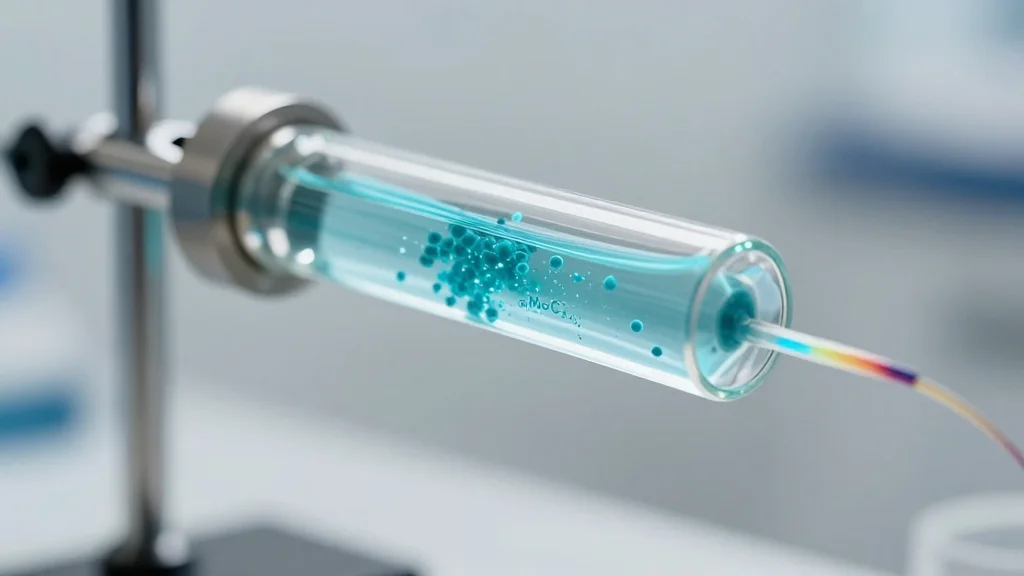
Decoding Α‐MoC1−x Nanoparticle Formation in Continuous Flow via Machine Learning
Why It Matters
The approach provides a cost‑effective route to noble‑metal‑like catalysts while demonstrating how AI can accelerate nanomaterial design, a critical need for sustainable industrial chemistry.
Key Takeaways
- •Continuous‑flow method produces α‑MoC₁₋ₓ nanoparticles from Mo(CO)₆
- •In‑line spectroscopy combined with ML deconvolutes overlapping spectral features
- •ML model identifies two‑step pathway; amorphous intermediate precedes crystallization
- •First conversion step is rate‑limiting, guiding reactor optimization
- •SAXS and XRD validate predicted concentration profiles and crystal formation
Pulse Analysis
Molybdenum carbide nanoparticles have emerged as a compelling alternative to precious‑metal catalysts, offering comparable activity for hydrogenation and reforming reactions at a fraction of the cost. Traditional batch syntheses, however, suffer from poor reproducibility and limited scalability, prompting researchers to explore continuous‑flow reactors that deliver precise temperature and residence‑time control. By leveraging a mild flow‑based process, the study reduces energy input and minimizes hazardous by‑products, positioning α‑MoC₁₋ₓ as a viable candidate for large‑scale catalytic applications.
The breakthrough lies in integrating in‑line spectroscopic monitoring with a multilayer perceptron machine‑learning algorithm capable of untangling complex, nonlinear spectral signatures. This AI‑driven analysis uncovered a two‑step reaction mechanism: an initial, rate‑limiting conversion of Mo(CO)₆ to an amorphous intermediate, followed by intraparticle crystallization into the desired carbide phase. Real‑time concentration profiles generated by the model were cross‑validated with small‑angle X‑ray scattering and X‑ray diffraction, confirming both the intermediate’s existence and the timing of crystallization. Such mechanistic clarity enables engineers to fine‑tune flow parameters, improve yield, and reduce waste.
Beyond the specific chemistry, the work illustrates a template for self‑optimizing nanomaterial synthesis platforms. By automating data acquisition and applying machine‑learning deconvolution, laboratories can accelerate discovery cycles, rapidly iterate formulations, and scale promising catalysts without extensive trial‑and‑error. The methodology is transferable to other transition‑metal carbides, oxides, and alloy nanoparticles, heralding a new era where AI‑enhanced flow chemistry drives cost‑effective, sustainable production for energy, automotive, and chemical sectors.
Decoding α‐MoC1−x Nanoparticle Formation in Continuous Flow via Machine Learning
Comments
Want to join the conversation?
Loading comments...