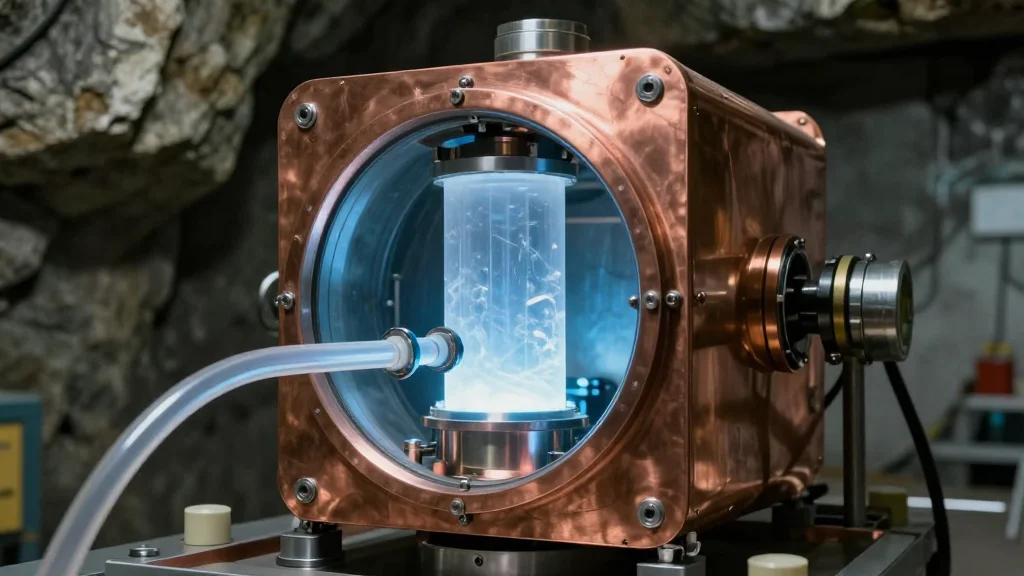
Deep Beneath Earth’s Surface, a Dark Matter Detector Is Ready to Make History
Why It Matters
A detection would solve a fundamental mystery in cosmology and open a new frontier for particle physics, while a null result would sharply constrain theoretical models, guiding future research and investment in the multi‑billion‑dollar dark‑matter sector.
Summary
Physicists at Stanford’s SLAC National Accelerator Laboratory have completed construction of a next‑generation dark‑matter detector housed 1.5 km underground, where cosmic radiation is dramatically reduced. The experiment, named SuperCDMS SNOLAB, employs ultra‑cold germanium and silicon crystals to sense the faintest particle interactions, aiming for sensitivity up to 100 times greater than previous searches. Commissioning is slated to begin later this year, with the first data runs expected in early 2027. If successful, the detector could either confirm the existence of weakly interacting massive particles (WIMPs) or rule out large swaths of the leading dark‑matter parameter space.
Deep Beneath Earth’s Surface, a Dark Matter Detector Is Ready to Make History
Comments
Want to join the conversation?
Loading comments...