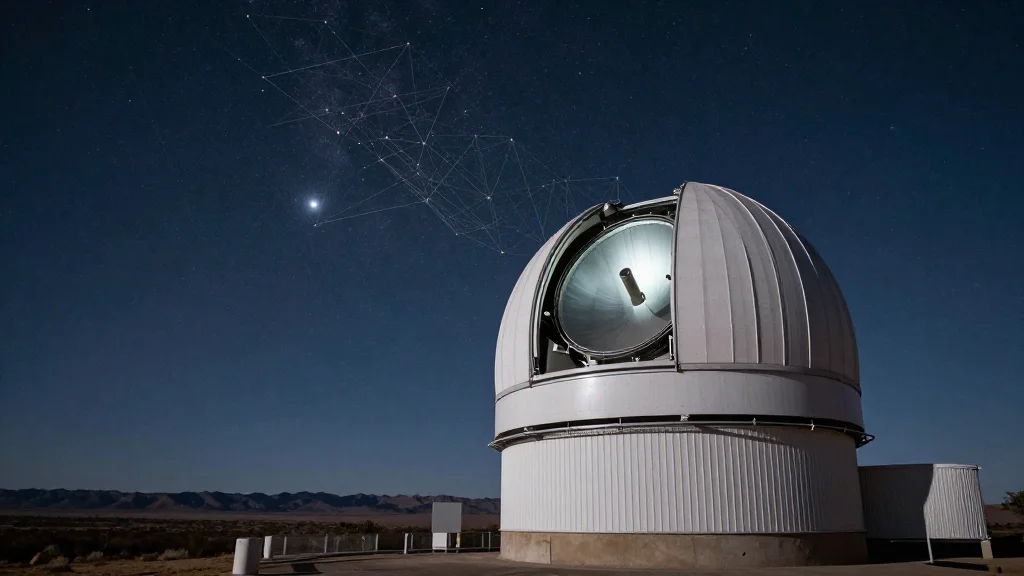
DESI Completes Largest 3D Cosmic Map, Boosting Dark Energy Research

Why It Matters
The completion of DESI’s five‑year survey provides the most comprehensive three‑dimensional map of the observable universe, a critical tool for probing dark energy, which accounts for roughly 70 % of the cosmos. By delivering precise measurements of galaxy clustering and the expansion rate across cosmic time, the dataset allows scientists to test whether dark energy is static or dynamic, a question that underpins our understanding of the universe’s ultimate fate. Beyond fundamental physics, the DESI map serves as a legacy resource for a broad range of astrophysical investigations, from galaxy evolution to the distribution of quasars and the intergalactic medium. Its open‑access policy ensures that researchers worldwide can leverage the data, fostering collaboration and accelerating discovery across multiple sub‑fields of astronomy.
Key Takeaways
- •DESI finished a five‑year survey ahead of schedule, mapping >47 million galaxies and quasars
- •The dataset includes 20 million stars and six times more objects than all prior spectroscopic surveys combined
- •More than 900 researchers from 70+ institutions contributed, with Ohio State leading instrumentation and analysis
- •The survey overcame a 2022 wildfire that cut power and internet at Kitt Peak for months
- •First full‑survey results are slated for release in 2027, with observations continuing through 2028
Pulse Analysis
DESI’s rapid completion and the sheer scale of its dataset represent a watershed moment for observational cosmology. Historically, progress in dark energy research has been limited by the sparsity of high‑precision redshift measurements; DESI flips that paradigm by delivering a dense, uniform sampling of the cosmic web. This density not only tightens constraints on the equation‑of‑state parameter w but also opens the door to novel cross‑correlations with upcoming imaging surveys such as the Vera C. Rubin Observatory’s LSST. The synergy between spectroscopic depth and imaging breadth could finally resolve the current Hubble tension by providing an independent ladder anchored in large‑scale structure.
From a strategic standpoint, DESI showcases the power of large, internationally coordinated projects funded by a mix of DOE, NSF, and university resources. The successful navigation of operational setbacks—most notably the 2022 wildfire—demonstrates a resilience that will be essential for future facilities like the Nancy Grace Roman Space Telescope, which will rely on similar collaborative frameworks. As the community digests the first DESI results in 2027, the emphasis will shift from data collection to model discrimination, potentially prompting a revision of the standard ΛCDM paradigm if deviations persist.
Looking ahead, the continuation of DESI observations through 2028 ensures that the map will be refined and expanded, maintaining its relevance as a benchmark for next‑generation surveys. The legacy of DESI will likely be measured not just by the papers it produces, but by how it reshapes the methodological toolkit of cosmology—making high‑precision, large‑volume spectroscopy a standard component of the field’s investigative arsenal.
DESI Completes Largest 3D Cosmic Map, Boosting Dark Energy Research
Comments
Want to join the conversation?
Loading comments...