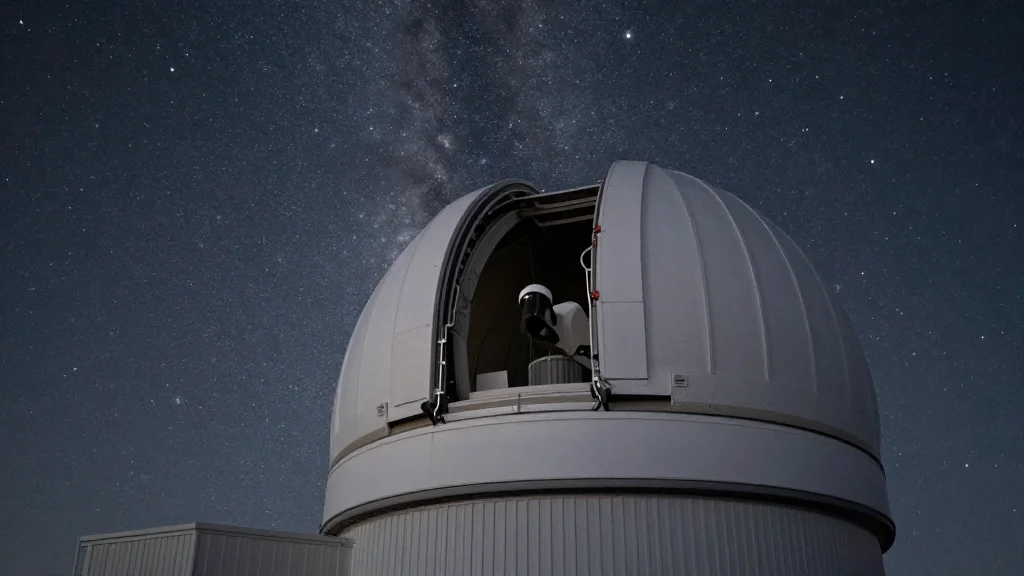
DESI Completes Largest‑Ever 3‑D Cosmic Map, Charting 47 Million Galaxies

Why It Matters
The DESI map provides the most comprehensive three‑dimensional view of the Universe’s structure, giving researchers a powerful dataset to test fundamental physics. By probing dark energy across billions of years, the survey tackles the most pressing question in cosmology: what is driving the accelerated expansion of space? Beyond pure science, the project's success showcases the capability of large, international collaborations to deliver massive data streams and process them in near real time. The techniques refined by DESI will inform future astronomical surveys and could spill over into other data‑intensive fields, from climate modeling to genomics.
Key Takeaways
- •DESI completed its five‑year survey on April 15, mapping >47 million galaxies and quasars.
- •The instrument exceeded its original goal of 34 million objects, cataloguing 20 million additional stars.
- •Nightly data flow of ~80 GB is processed by supercomputers for near‑real‑time analysis.
- •Early results suggest possible evolution of dark energy, challenging the ΛCDM model.
- •Funding extension through 2028 will expand coverage and increase data density.
Pulse Analysis
DESI’s achievement represents a watershed for observational cosmology, not merely because of the sheer volume of data but because of the precision with which it captures the Universe’s large‑scale structure. The instrument’s robotic fibre positioners, capable of aligning to within a hair’s width, have turned what was once a statistical exercise into a high‑resolution mapping effort. This level of detail narrows uncertainties on key cosmological parameters, allowing theorists to test subtle deviations from the standard model that were previously hidden by noise.
Historically, each generation of redshift surveys—such as the Sloan Digital Sky Survey (SDSS) and the Baryon Oscillation Spectroscopic Survey (BOSS)—has pushed the frontier of cosmic cartography. DESI builds on that legacy by delivering a dataset that is both broader in scope and finer in resolution. The extension to 2028 is strategic: it aligns DESI’s timeline with upcoming missions like Euclid and LSST, creating a synergistic data ecosystem. Joint analyses will enable cross‑validation of results, reducing systematic errors and strengthening confidence in any detected anomalies.
Looking forward, the real test will be whether the full DESI dataset confirms the tentative signs of evolving dark energy. If the signal holds, it could trigger a paradigm shift, prompting revisions to the cosmological constant and sparking new theoretical work on scalar fields or modified gravity. Even a null result—reinforcing a constant dark energy—will be valuable, tightening constraints and guiding the next generation of experiments. In either case, DESI has set a new benchmark for what collaborative, data‑heavy science can achieve, and its legacy will shape cosmology for decades.
DESI Completes Largest‑Ever 3‑D Cosmic Map, Charting 47 Million Galaxies
Comments
Want to join the conversation?
Loading comments...