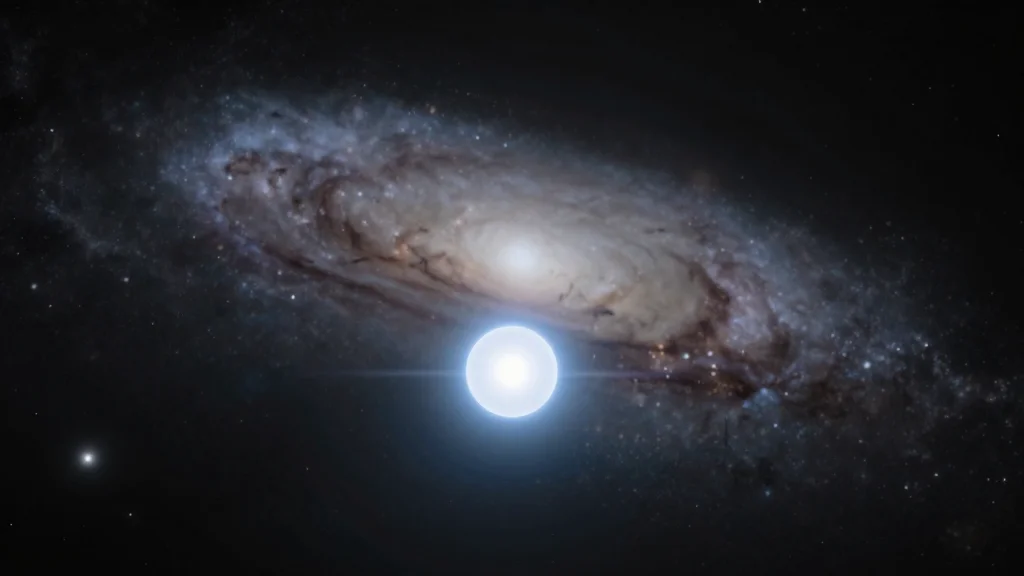
DESI-HVS1 Is an Old Hypervelocity Star Ejected From the Galactic Center, Observations Suggest
Why It Matters
The discovery proves the Galactic Center can fling ancient, low‑mass stars, reshaping models of black‑hole dynamics and stellar ejection rates. It also offers a new probe of the Milky Way’s gravitational potential.
Key Takeaways
- •DESI-HVS1: 0.76 M☉, 14 Gyr old, metal‑poor.
- •Velocity 523 km/s, near Milky Way escape speed.
- •Traced back 12.9 Myr to within 1,300 ly of GC.
- •First old, low‑mass HVS linked to Galactic Center.
- •Supports Hills mechanism for diverse stellar masses.
Pulse Analysis
Hypervelocity stars have long fascinated astronomers because they carry the kinetic imprint of extreme gravitational encounters. Most confirmed cases are young, massive O‑ or B‑type stars, a bias driven by their brightness and the ease of measuring precise motions. The Hills mechanism—where a binary system is torn apart by the supermassive black hole at the Milky Way’s core—predicts a broader mass spectrum, yet observational evidence has been scarce. Large‑scale spectroscopic campaigns like DESI, combined with Gaia’s astrometric precision, now enable the detection of fainter, older objects that were previously hidden in the halo.
DESI‑HVS1 stands out for its antiquity and low mass. With a metallicity of –1.64 dex and an age exceeding 14 billion years, it likely formed in the early Milky Way or a dwarf galaxy that merged long ago. Its measured galactocentric velocity of roughly 523 km s⁻¹ places it at the threshold of escape, while backward orbit integration shows a close passage to the central black hole about 13 million years prior. This trajectory confirms the Hills mechanism can accelerate stars of any mass, suggesting that the central black hole’s ejection efficiency has been underestimated in galactic evolution models.
The broader implications extend to dark‑matter mapping and the Milky Way’s mass profile. Hypervelocity stars act as test particles, tracing the Galactic potential far beyond the solar circle. Adding an old, metal‑poor tracer like DESI‑HVS1 refines constraints on halo shape and mass distribution, which are critical for interpreting upcoming surveys such as the Vera C. Rubin Observatory’s LSST. As more low‑mass HVS candidates emerge, astronomers will gain a richer, statistically robust picture of the dynamic interplay between the central black hole and the surrounding stellar population, deepening our understanding of galaxy formation and evolution.
DESI-HVS1 is an old hypervelocity star ejected from the galactic center, observations suggest
Comments
Want to join the conversation?
Loading comments...